How to decide between Microbiome Marker Gene Sequencing (16S/18S/ITS) and Shotgun Metagenomics

A single gram of soil can hold tens of thousands of microbial species, but the overwhelming majority of them will never grow in a petri dish. Sequencing is how we can observe these microbes, offering a window into otherwise invisible communities and helping us understand who is there, how they interact, and what they may be capable of doing.
Plasmidsaurus offers two powerful services for studying the microbiome: Marker Gene Sequencing (16S/18S/ITS) and Shotgun Metagenomics. Each approach captures different information and comes with its own strengths, weaknesses, and best-use cases. Here, we'll break those down so you can decide which one fits your next microbiome project.
Microbiome Marker Gene Sequencing: who's there?
Marker gene sequencing has been the standard for community profiling for decades. Established in the 1980s, it is based on the idea that if you sequence a gene that every organism carries, you can identify what is in a sample without ever growing it.
Common marker genes include the 16S rRNA gene for bacteria and archaea, the 18S rRNA gene for microbial eukaryotes, and the internal transcribed spacer (ITS) region for fungi. Marker genes have conserved regions that let a universal primer pair amplify the gene from many organisms at once, while hypervariable regions act like fingerprints that can be matched against references to identify which taxa are present. How many sequencing reads come from each organism can also be used to estimate their relative abundance.
Plasmidsaurus Microbiome Marker Gene Sequencing uses Oxford Nanopore sequencing to read marker genes end to end. Unlike short-read approaches, which typically sequence only one or a few variable regions, long reads can span the full marker and capture more taxonomically informative sequences. This can improve taxonomic resolution and, for some organisms, enable species-level classification across 16S, 18S, and ITS targets (Curry et al., 2022; Zhang et al., 2023).
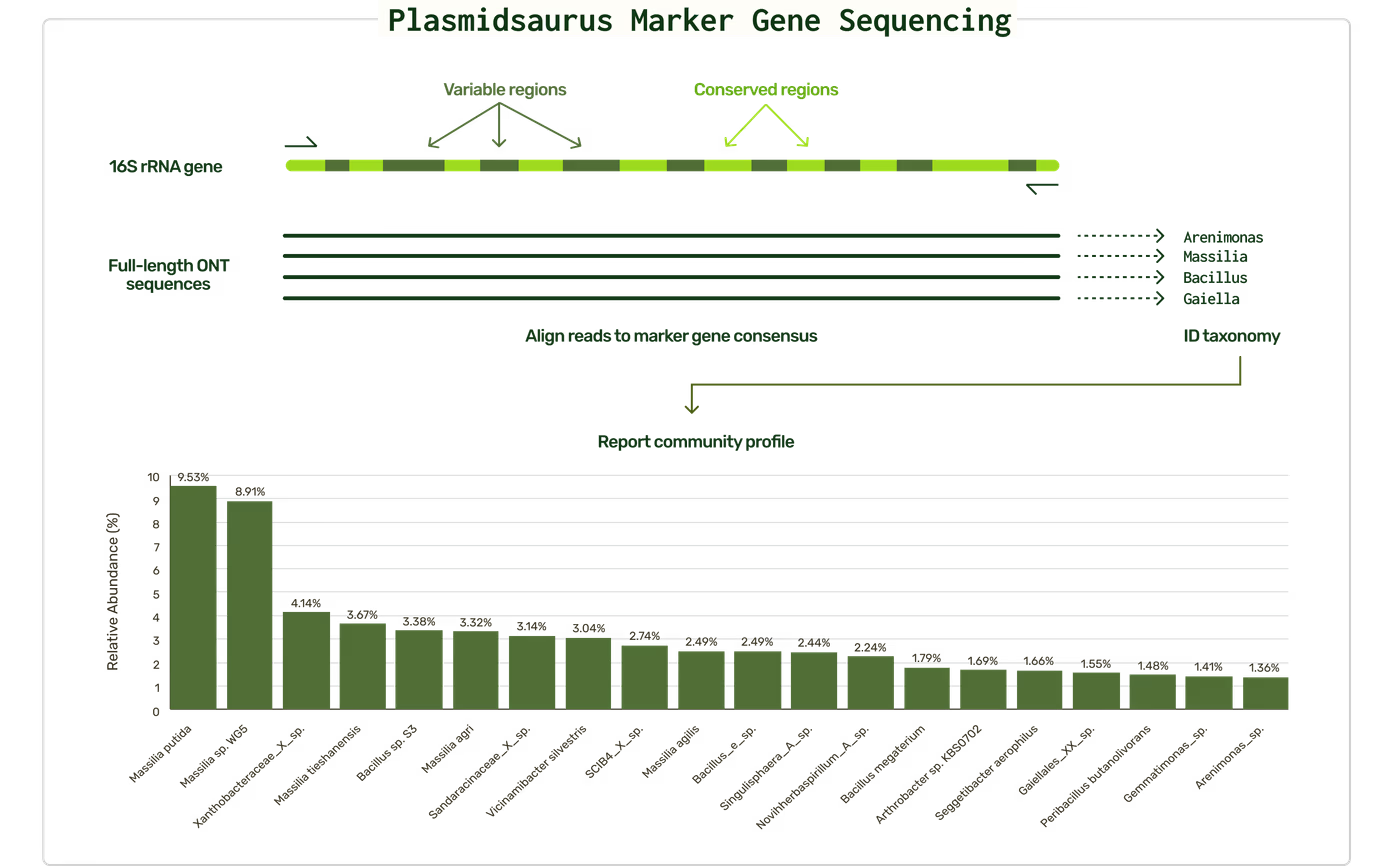
Because amplification selectively enriches the target marker, sequencing depth is concentrated on the microbial DNA of interest rather than all DNA in the sample. This makes the method particularly useful for community profiling in host-rich or low-input samples. However, it also makes the method sensitive to external contaminants, so extra care is needed when collecting and preparing samples.
Amplification also has the drawback of PCR bias. While universal primers have been optimized to bind to as many organisms as possible, no primer set binds equally well to every organism, so some taxa are amplified more efficiently than others, and some may be underrepresented or missed entirely. Marker gene copy number can also vary between organisms, meaning read counts do not translate directly into cell counts and can skew estimates of relative abundance (Louca et al., 2018).
Despite these limitations, marker gene sequencing remains a mainstay of microbial community profiling for two reasons. First, it is relatively inexpensive, making it possible to profile large numbers of samples and achieve the replication and statistical power needed to detect subtle ecological patterns. This scalability is particularly valuable for studies spanning many subjects, time points, environments, or experimental conditions.
Second, decades of widespread use has built an enormous amount of reference data. Resources such as SILVA and NCBI RefSeq Targeted Loci for 16S and other ribosomal RNA sequences, PR² for protist 18S sequences, and UNITE for ITS sequences provide deeply curated references for taxonomic classification.
The long history of marker gene sequencing also gives researchers a rich archive of past community profiles to revisit, making it possible to ask how microbial communities have changed over time or responded to environmental stressors (Shade et al., 2013). If your goal is to place a community in the context of existing literature or extend a study originally profiled by 16S/18S/ITS, sticking with the same method may be critical for making meaningful comparisons.
Shotgun Metagenomics: who's there and what can they do?
Shotgun metagenomics emerged in the early 2000s when advances in sequencing made it possible to read DNA directly from entire microbial communities. Unlike marker gene sequencing, it can profile bacteria, archaea, fungi, protists, and DNA viruses in a single experiment, while also revealing the genes they carry.
There are several ways to prepare DNA for shotgun metagenomics, depending on the sequencing platform and workflow. For Plasmidsaurus Shotgun Metagenomics, the DNA is first fragmented and tagged with sequencing adapters in a single step called tagmentation, then sequenced using Illumina technology. The resulting reads are classified taxonomically by matching short sequence patterns called k-mers against a database of reference genomes, which identifies the organisms present and helps estimate their relative abundance. Separately, reads are matched against reference gene catalogs to reveal the functional potential of the community.
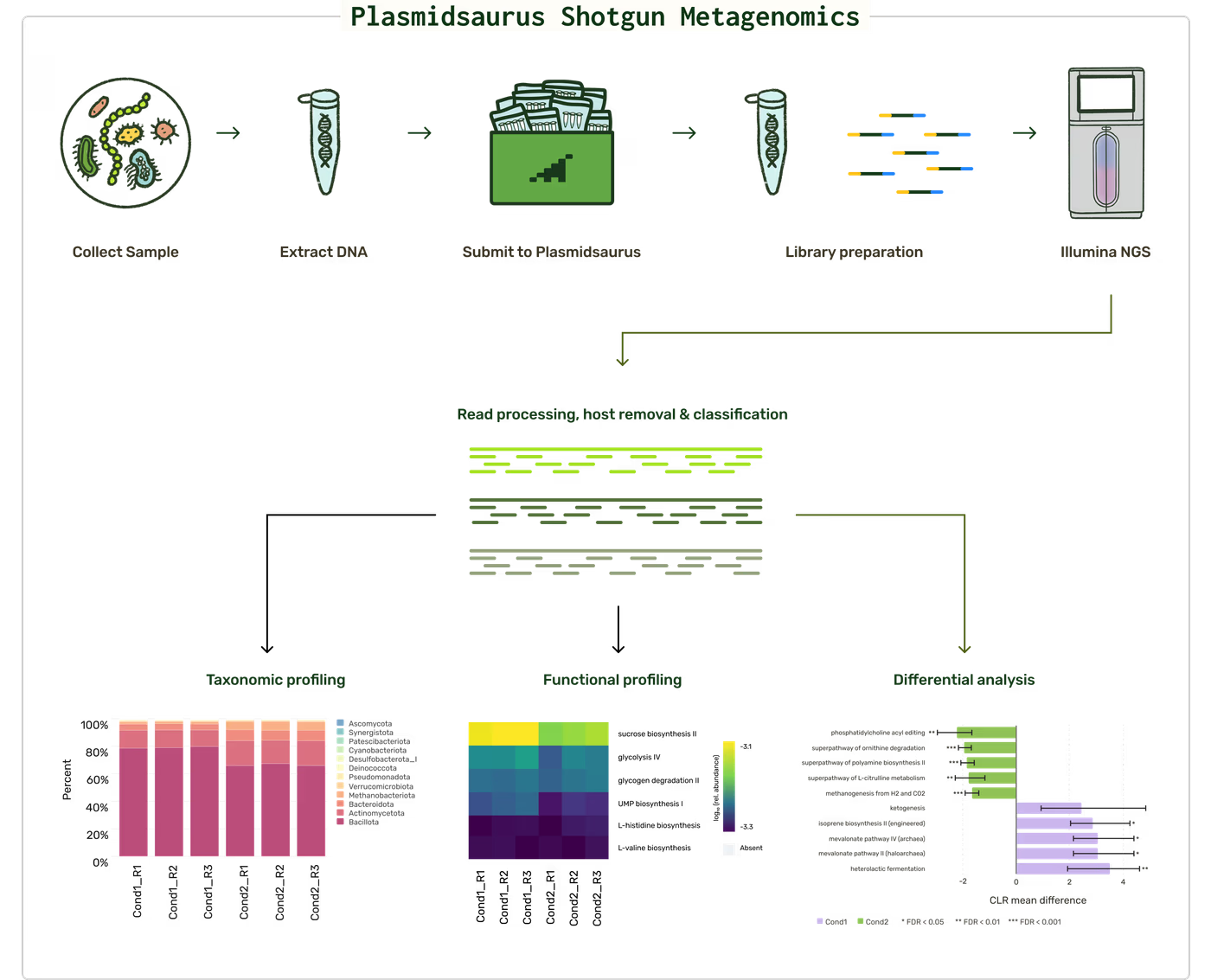
Because nothing is selectively amplified, a single shotgun experiment captures organisms across groups without committing to a marker in advance, which makes it well suited to communities that have not been profiled before. Without a marker-specific amplification step, no organism is systematically over- or under-amplified, though genome size and sequencing depth still shape what is detected and how it is weighted.
The gene-level information also opens up questions that marker gene sequencing cannot address directly, such as whether a community carries antimicrobial resistance genes, biosynthetic gene clusters, or particular metabolic pathways. Keep in mind, though, that DNA sequencing reveals what a community is capable of doing, not which genes are actively being expressed.
While the additional sequencing breadth can help you explore more kinds of questions, it also comes at a cost. Shotgun metagenomics needs more DNA than marker gene sequencing and is sensitive to sample composition and sequencing depth. In host-rich samples, host DNA can consume reads and reduce detection of low-abundance microbes.
Short reads can also make it difficult to link functional genes to the organisms carrying them, because gene identification and taxonomic analysis happen as two separate analyses. For projects where that genomic context is important, Plasmidsaurus also offers Metagenome-Assembled Genome (MAG) Sequencing as a custom service, using long-read adaptive sequencing and de novo assembly to help make those connections.
Choosing the right method for your project
You might be tempted to think of shotgun metagenomics as the "more advanced" version of marker gene sequencing, but they are better thought of as different tools for different questions — and, in some experiments, complementary approaches.
Microbiome Marker Gene Sequencing is a strong choice when you want to:
- Compare how bacterial, fungal, or microbial eukaryotic communities change across conditions such as treatment, location, diet, or time
- Profile large cohorts or many samples when replication, dense sampling, speed, and cost are priorities
- Work with host-rich or low-input samples, where selectively amplifying the microbial marker can concentrate sequencing on the organisms of interest
- Compare your results with well-curated reference databases and published datasets to place your microbial community in a broader context
Shotgun Metagenomics is a strong choice when you want to:
- Compare both taxonomic composition and functional potential across conditions such as healthy vs. diseased, treated vs. untreated, or responder vs. non-responder groups
- Characterize previously unexplored microbial communities without choosing a marker or taxonomic group in advance
- Detect and characterize bacteria, archaea, fungi, protists, and DNA viruses together in the same experiment
- Investigate genes and metabolic pathways, including antimicrobial resistance genes, biosynthetic gene clusters, and carbohydrate-active enzymes (CAZymes)
Some projects might call for both: first screening a large sample set by marker gene, then going deep on the conditions that stand out. If you do run both, be aware that the taxonomic profiles reported by both may differ, sometimes substantially. This is expected, and it does not mean one dataset is wrong. Classification depends on the reference database and analysis method as well, and marker and genome-based databases differ in coverage, taxonomy, and naming.
The practical implication is to compare samples within a method rather than across them. Choose the approach that answers your question, apply it consistently across the study, and treat cross-method comparisons as qualitative.
Ready to profile your microbial communities? Try Plasmidsaurus Marker Gene Sequencing, Shotgun Metagenomics, or custom MAG Sequencing today!
References
Curry, K.D. et al. Emu: species-level microbial community profiling of full-length 16S rRNA Oxford Nanopore sequencing data. Nat. Methods. 19: 845–853 (2022). doi: 10.1038/s41592-022-01520-4
Louca, S., Doebeli, M. & Parfrey, L.W. Correcting for 16S rRNA gene copy numbers in microbiome surveys remains an unsolved problem. Microbiome. 6: 41 (2018). doi: 10.1186/s40168-018-0420-9
Shade, A., Caporaso, J.G., Handelsman, J., Knight, R. & Fierer, N. A meta-analysis of changes in bacterial and archaeal communities with time. ISME J. 7: 1493–1506 (2013). doi: 10.1038/ismej.2013.54
Zhang, T. et al. The newest Oxford Nanopore R10.4.1 full-length 16S rRNA sequencing enables the accurate resolution of species-level microbial community profiling. Appl. Environ. Microbiol. 89: e00605-23 (2023). doi: 10.1128/aem.00605-23
By:
Ella Watkins-Dulaney, PhD
Science Writer, Plasmidsaurus
With technical review by:
Nick Scales, PhD
Technical Sequencing Specialist, Plasmidsaurus
Maggie Weitzman
Director of Special Research Projects, Plasmidsaurus
PS-0027-E | v1.0 | Revised Oct. 2, 2026