Shortening the loop from design to data: Syntax Bio uses sequencing to program better stem-cell therapeutics

Syntax Bio is reprogramming stem cells with CRISPR instead of growth factors. Plasmidsaurus RNA-Seq turned their core optimization workflow from a months-long bottleneck into a three-day readout, and the founders say it changed what the company could attempt and achieve.
Programming differentiation from within
Many stem-cell-derived therapies begin with pluripotent stem cells that are coaxed, step by step, toward a therapeutic cell type using growth factors and small molecules. Depending on the target cell, this process can take 50 to 120 days. The materials are expensive and often sourced overseas, adding cost and supply-chain risk to an already complex manufacturing process.
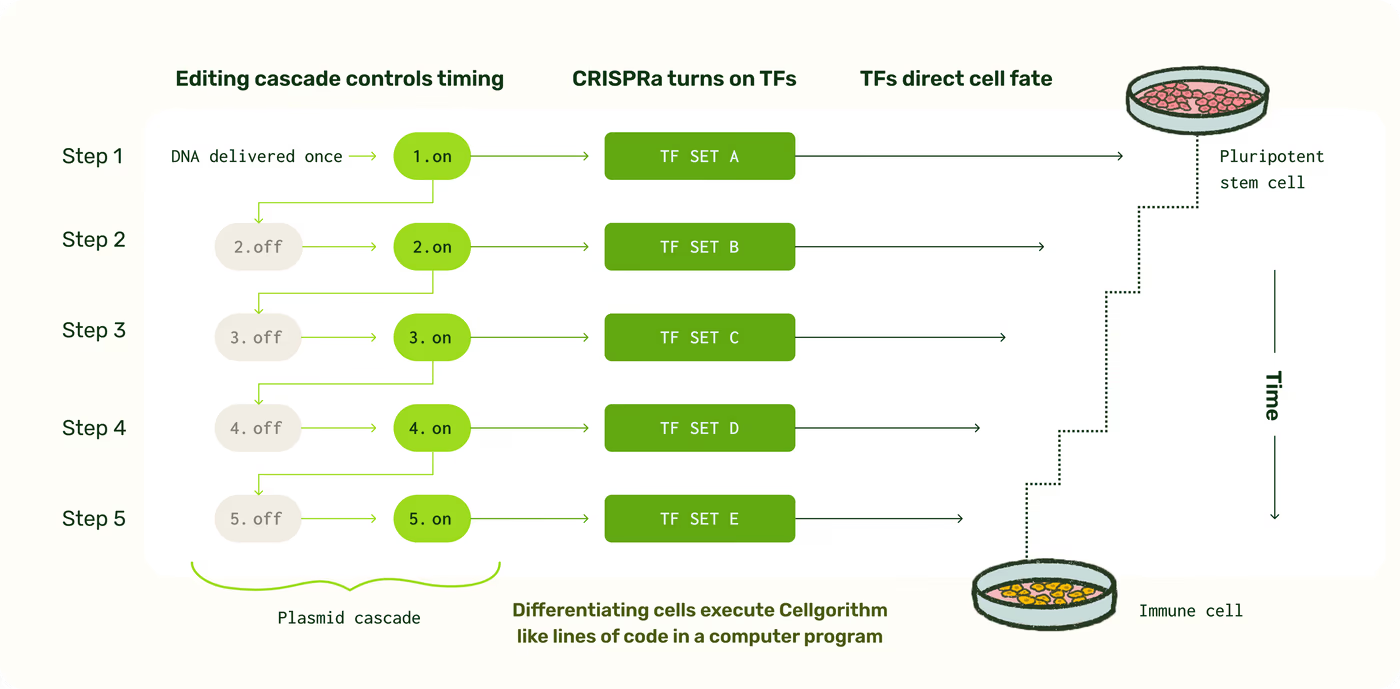
Syntax takes a different approach. Instead of guiding cells with external chemical cues, the company uses “programmable genetics” and a modified CRISPR system to activate transcription factors in a defined sequence from within a cell, recreating the developmental trajectory that leads to a target cell type.
"In language, syntax is the ordering of grammar.
We design the syntax of differentiation."
Nikolas Balanis, CTO of Syntax Bio.
Syntax encodes their program on a set of plasmids it calls a cellular algorithm, or “Cellgorithm.” After a one-time delivery, the plasmids execute the program through up to 10 steps, each lasting four to six hours. Differentiation protocols that once took 50 to 120 days can now be completed in five to seven.
Two bottlenecks slowed every iteration
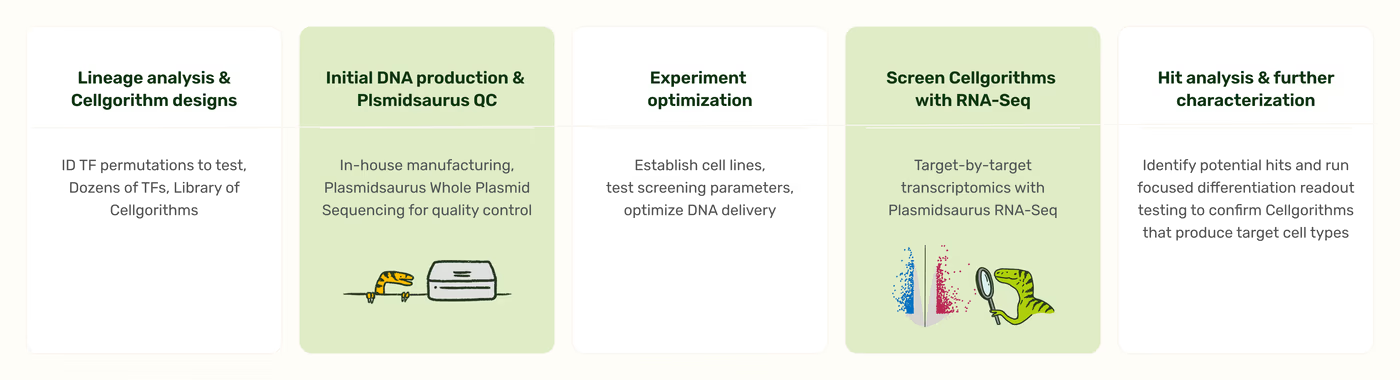
Building a successful Cellgorithm requires Syntax to test many combinations of transcription factors, guides, order, and timing. Even a single round of development can involve dozens to hundreds of plasmid constructs, followed by characterization experiments to determine how those designs affect the cell’s trajectory and fate. As the number of designs grew, two parts of this cycle became difficult to scale.
The first was construct verification. Every plasmid had to be sequence-verified before it could be delivered into pluripotent stem cells. With Sanger sequencing, confirming a full construct required assembling multiple reads, making verification increasingly slow and cumbersome at higher volumes. Plasmidsaurus Whole Plasmid Sequencing allows Syntax to confirm the entire construct, including the insert and backbone, in a single fast and easy sequencing step.
The second was measuring what happened after delivery. Syntax initially relied on RT-qPCR, a hands-on workflow that measured expression one gene at a time and could take days to complete. Plasmidsaurus RNA-Seq replaced that narrow readout with a transcriptome-wide view returned in three days. With no hands-on bench work required, the team could determine whether CRISPRa had activated the intended transcription factor while also seeing how the broader gene-expression program responded. The extra signal has proved valuable in ways the team did not anticipate, including guiding new approaches for Cellgorithm design.
"Plasmidsaurus RNA-Seq is kind of set-it-and-forget-it. It's really hard to mess up."
Caspian Harding, Scientist
| RT-qPCR | Fragmentation-based RNA-Seq | Plasmidsaurus RNA-Seq | |
|---|---|---|---|
| Hands on time | High (2-4 days) | Low/medium | Almost none |
| Data delivery time | 3-4 days + 1 week for probe failures | 3+ weeks 4+ weeks with RNA-extraction | 3 days
|
| Data output | Single gene expression | Full transcriptome | Poly-adenylated transcripts |
| Data use | Target gene activation | Target gene activation Cross-target activation Informs Cellgorithm design | Target gene activation Cross-target activation Informs Cellgorithm design |
Faster iteration unlocked better Cellgorithm design
With faster construct verification and transcriptome-wide readouts, Syntax finally had the bandwidth to optimize designs at a scale that had previously been impractical.
"We knew what we had to do. We just couldn’t do it fast enough."
Nikolas Balanis, CTO of Syntax Bio
One opportunity was to identify more efficient guide combinations. Finding the strongest combination requires testing many variations, a process that was too slow and labor-intensive to pursue systematically with qPCR.
Plasmidsaurus RNA-Seq made large-scale guide screening practical. With it, they have found better combinations of guides, while also improving overall Cellgorithm efficiency at the same time. It is now Syntax’s default readout for Cellgorithm development and for optimization experiments conducted between larger differentiation screens.
Building a cumulative learning loop
Beyond improving individual experiments, Syntax is using the RNA-Seq data it generates to build a dataset that becomes more valuable with each new result.
"The data we’re getting is so multifactorial, multiparametric, and high-dimensional that there’s so much opportunity to learn."
Nikolas Balanis, CTO of Syntax Bio
To make that information easier to learn from, Syntax has built an automated pipeline that combines Plasmidsaurus RNA-Seq results with sample metadata from their electronic lab notebook system. The team recently had roughly 100 datasets reprocessed, bringing three years of RNA-seq data together in a form that scientists across the company can query and analyze.
This infrastructure allows Syntax to look beyond the original question behind each experiment. The team can mine results from many activations and guide combinations, investigate patterns it may not have anticipated, and test new hypotheses against data it has already generated before deciding whether another experiment is needed. AI-assisted programming and analysis tools are making that accumulated dataset even easier to explore.
From better experiments to better therapeutics
For Syntax, the impact of faster sequencing is cumulative. Whole Plasmid Sequencing removes friction before an experiment begins, while RNA-Seq delivers the broader readout needed to effectively assess the performance of each Cellgorithm. Together, they have shortened the cycle between building a Cellgorithm, learning from it, and designing the next version.
That tighter feedback loop has expanded what Syntax can realistically explore. The team can test more ideas, systematically evaluate guide combinations, and carry each result into both the next Cellgorithm and a growing archive of RNA-Seq data.
"I honestly don’t know if Syntax could exist without us finding this. It came like a bolt of lightning."
Nikolas Balanis, CTO of Syntax Bio
By converging on better Cellgorithm designs sooner, Syntax can accelerate the path toward therapeutic development—and toward the larger goal that motivates the platform in the first place: bringing stem-cell-derived therapies to the patients who need them.