| Service Level | Read Depth | Sample Input | Input Quantity* | Buffer |
|---|---|---|---|---|
| Standard | 2-5K reads/sample | Purified AAV capsids | 2-5 × 10¹¹ vector genomes | 200 µL of any common AAV formulation buffer or PBS 200 µL stabilized in 1X Zymo DNA/RNA Shield |
| Big | 15-20K reads/sample | |||
| Full flow cell | Up to 20M reads/flow cell |
*Note, you can submit a minimum of 1 × 10¹¹ vector genomes, but we recommend 2-5 × 10¹¹ for best results.
Purify your viral capsids.
We accept only purified viral capsids. Affinity resin or ultracentrifugation purified AAV samples perform best. At this time total cell lysate with or without detergent does not generate a useful number of reads in our AAV sequencing service.
Requirements for best results
- All samples must be free of cellular debris and must be treated with DNase or Benzonase before being shipped to us. We do not treat AAV samples with DNase prior to DNA extraction.
- Crude PEG-precipitated virus that has been resuspended in PBS or similar buffer is compatible with our system but requires clarification before sending material. Centrifuging at 3000 RCF for 10 minutes then recovering the supernatant into a new tube while avoiding the pellet is sufficient clarification.
- Our protocol is compatible with common AAV formulation buffers as well as simple PBS or TBS. Low concentrations of Mg²⁺, glycerol, and PF-68 do not interfere with extraction or sequencing. If the sample is in a high salt solution (e.g. neutralized elution buffer from an affinity purification) we recommend buffer exchanging into PBS or a similar common formulation buffer.
- For samples stabilized in 1X Zymo DNA/RNA Shield:
Submit 200 µL final volume of a minimum of 1x10¹¹ vg of AAV in 1X final concentration Zymo DNA/RNA shield in PCR strip tubes. We recommend submitting 2-5x10¹¹ vg since ITR-directed PCR quantitation tends to over-estimate intended AAV transgene titer.
Zymo Research sells at 2X concentrate (Product #R1200-25) that can be added at equal volume to 100 µL of any common virus storage buffer.
- For international shipments we are not able to accept samples from BSL2 organisms or above.
Prepare your samples.
Submit a minimum of 1.0 × 10¹¹ total vector genome (vg) copies of purified intact AAV viral capsids as determined by qPCR or ddPCR. For best results, we recommend sending 2-5 × 10¹¹ vg/sample. The most common cause for sequencing failure is insufficient DNA input.
Capsids can be sent in a volume of up to 200 µL of buffered saline or common AAV storage solutions. Please do not send larger volumes of sample since only 200 µl will be processed in our workflow.
For international AAV shipments there is an additional requirement to preserve and inactivate your cells, as live viral capsids cannot be imported into the US. The samples need to be specifically preserved in Zymo DNA/RNA Shield (2X Concentrate) before shipping.
Please note:
- We have noticed that commonly used ITR-directed qPCR primers tend to over-estimate vector genome content.
- If you have dilute AAV that cannot achieve 1.0 × 10¹¹ vg in 200 ul (i.e. <5 × 10¹¹ vg/mL), we can still process the samples but the returned read-depth will be lower than our target range. Please contact support@plasmidsaurus.com first before sending us low titer samples.
Label your tubes.
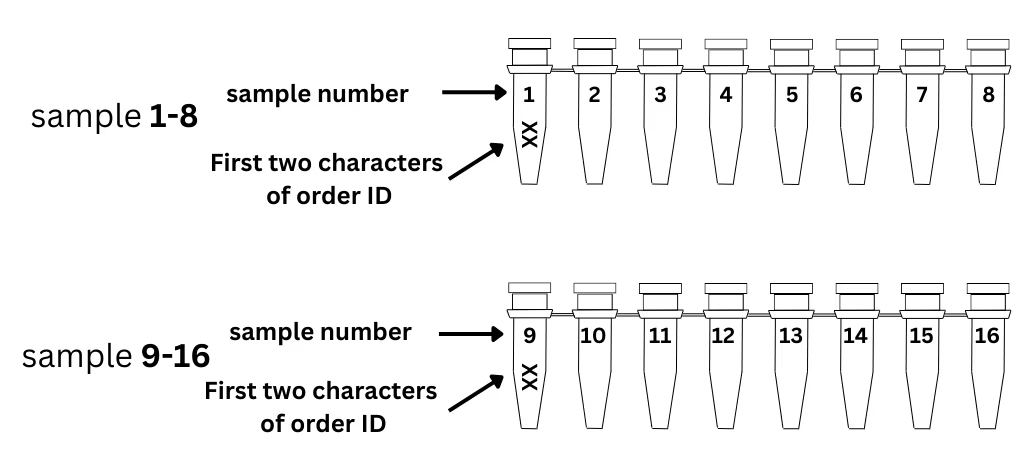
Make sure you are using the right 200 μL PCR strip tubes for your order.
- We have found that PCR strip tubes with individual swing-caps work best and are the least likely to leak. We recommend Eppendorf 0.2mL 8-Strip PCR Tubes with Hinged Flat Caps.
- Please do not send precious AAV samples in strip cap tubes like these. We have found that the lids leak even after being wrapped in parafilm!
- If your AAV sample is being sent from a CDMO or third party holding facility which cannot repackage the material into 200 μL PCR strip tubes, please notify support@plasmidsaurus.com when you send the samples. We can accommodate other packaging formats, but this may add to processing time.
Set up your order online and receive your unique 6-character order ID.
Write the first 2 characters of your order ID on the 1st tube of each strip.
Package and ship your samples.
Please do not use one of our shipping labels or dropboxes for dry ice shipping. Dry ice is considered a hazardous material and requires additional labeling and documentation. Please use your own courier service for shipments containing dry ice.
From within the US
You may choose from several options:
- Pack your intact AAV capsid samples with the QR code and cold pack in a styrofoam box and ship directly to our South San Francisco lab (address below).
- Stabilize and inactivate your samples in Zymo DNA/RNA Shield and deposit in your local dropbox. Print your order form, fold it so the QR code is readily visible, and place it in a small bag with your samples for submission.
Dropbox submissions cannot include cold packs or dry ice. Because these are re-shipped to our South San Francisco lab, expect an additional 3 business days of turnaround time. Do not pack samples into styrofoam containers or cardboard boxes for dropbox submissions.
From outside the US
Samples shipped from outside the US must be stabilized and inactivated with Zymo DNA/RNA Shield.
- You may ship directly to our South San Francisco lab. Due to international shipping constraints, customers outside the US must follow additional preparation steps and include supplementary shipping documentation. See the details below.
- Samples stabilized in Zymo DNA/RNA Shield may be submitted to your local dropbox. Print your order form, fold it so the QR code is readily visible, and place it in a small bag with your samples for submission.
Dropbox submissions cannot include cold packs or dry ice. Because these are re-shipped to our South San Francisco lab, expect an additional 3 business days of turnaround time. Do not pack samples into styrofoam containers or cardboard boxes for dropbox submissions.
Ship-to address
Plasmidsaurus
2 Tower Place, Suite 1500
South San Francisco, CA 94080
Expect delays for international packages due to customs regulations. Samples must be stabilized and inactivated with Zymo DNA/RNA Shield for ambient temperature shipping.
Please submit your samples to:
Plasmidsaurus
2 Tower Place, Suite 1500
South San Francisco, CA 94080
Please print, fill out, and include the following documents:
- Commercial Shipping Invoice - AAV - for best results, make sure to include the shipper's identity, shipper's address, and the quantity of items within the shipment
- Detailed Description - AAV
- Toxic Substances Control Act (TSCA) Certificate - AAV
If you have any questions, please contact our support team (support@plasmidsaurus.com) to ensure the correct commercial invoice, USDA, and customs forms are included for import in to the USA.
Further guidance for international shipping
- The information below constitutes only a recommendation for shipping samples classified as "non-regulated materials" to our facility. Due to continuing changes in state and federal regulations, clients should always check with their safety office and/or shipping department to ensure regulatory compliance.
- Make sure all forms are fully completed. Incomplete and/or missing forms will likely cause delays and other issues.
- Keep an eye out for any communication or information requests from your shipping company of choice in case of issues. It is your responsibility to provide any information they request, and we advise following their guidance as their systems will have the most up-to-date customs information.
Why do I need these forms? Read more here.
- Samples must be packaged and shipped in accordance with U.S. Department of Transportation (DOT) and/or International Air Transport Association (IATA)/ International Civil Aviation Organization (ICAO) and carrier regulations.
- Your international courier will require you to complete a commercial invoice to be included with the shipment.
- The commercial invoice should describe the contents as “non-hazardous, non-contagious research sample.” Please list your institution as the "Manufacturer" of the samples if Manufacturers Identification (MID) code is required.
- State that the “contents are Not Restricted under IATA DGR regulations.”
- We recommend that you include a Toxic Substance Control Act (TSCA) Certification. If you do not include this, the package may be delayed at customs until the courier receives the proper certification.
- Declare the value of the goods to be $1.
- We only accept AAV samples that are intended for Research Use Only! We DO NOT accept any samples for clinical diagnostics or trials. Any samples that do not conform to our submission guidelines will be discarded and/or submitted to the United States Postal Inspection Service
- If shipping to Cologne, certain sample types will require some additional information. Please reach out to support if you have any questions.
Category B infectious substances (UN 3373) are classified as being potentially harmful to humans or animals and must be packed in accordance with ADR (International carriage of dangerous goods by road) packing instruction PI 650 for road transport and IATA packing instruction PI 650 for air transport. - Unlike other dangerous goods, UN3373 shipments do not require a Shipper's Declaration. However, the Air Waybill (AWB) must include: “UN3373, Biological Substance, Category B” Net quantity
- UN3373 (Biological Substance, Category B) requires triple packaging per Packing Instruction 650 (PI650) to ensure safe transport. This consists of a leakproof primary receptacle, a leakproof secondary packaging with absorbent material, and a rigid outer package, with proper labeling (UN3373 diamond).
- Shipping UN 3373 Biological Substances (Category B) into Germany requires strict adherence to international (IATA for air, ADR for road) and national regulations to ensure safety and compliance with customs. Please make sure you are following these regulations.
- The commercial invoice should describe the contents as “non-hazardous, non-contagious research sample.” Please list your institution as the "Manufacturer" of the samples if Manufacturers Identification (MID) code is required.
- Please make sure to use the correct HTS code to ensure fastest processing. The HTS code we use for our shipments is found on the template commercial invoice document above.
- We recommend including a detailed customs description (the template for which can be found above), or a Material Data Safety Sheet (if you have one already available for your samples). This is not required, but can be requested by customs if a delay occurs.