
Molecular biology cloning has followed a familiar rhythm for a very long time:
Build. Transform. Plate. Pick. Grow. Miniprep. Sequence. Verify. Experiment. Over and over again…
But there's a frustrating bottleneck in this workflow: you don't know which clones are correct until the sequencing results come back. You can pause your experiment while you wait, or move forward with multiple clones, knowing you'll eventually have to discard the incorrect ones.
Either way, you spend extra time, reagents, and effort on constructs that are redundant or outright wrong.
What if you could confirm your sequences earlier and keep your experiments moving with less work?
With ZeroPrep Colony Sequencing, you can.
What is ZeroPrep?
ZeroPrep is Whole Plasmid Sequencing before the miniprep. Instead of sending purified DNA, send us your E. coli colonies on an agar plate, colonies resuspended in LB, or liquid cultures. We handle the extraction and sequencing, then return a fully annotated plasmid sequence overnight for just $5 more per sample.
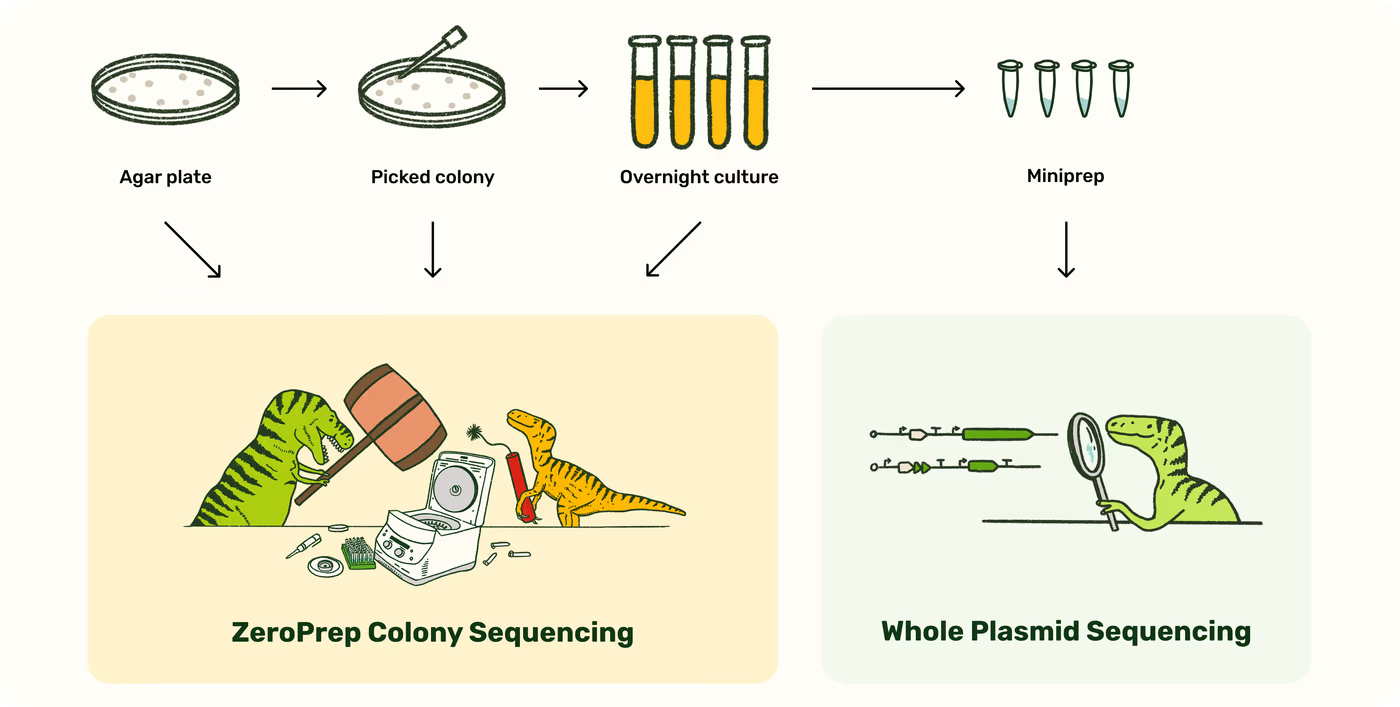
How ZeroPrep fits into your workflow
ZeroPrep is designed to fit into the way you already clone, whether you prefer to send overnight cultures or sequence directly from colonies. Depending on when you submit your samples, you can skip unnecessary minipreps, get answers a day earlier, or even verify your clones the same afternoon.
Here are three ways to fit ZeroPrep into your week:
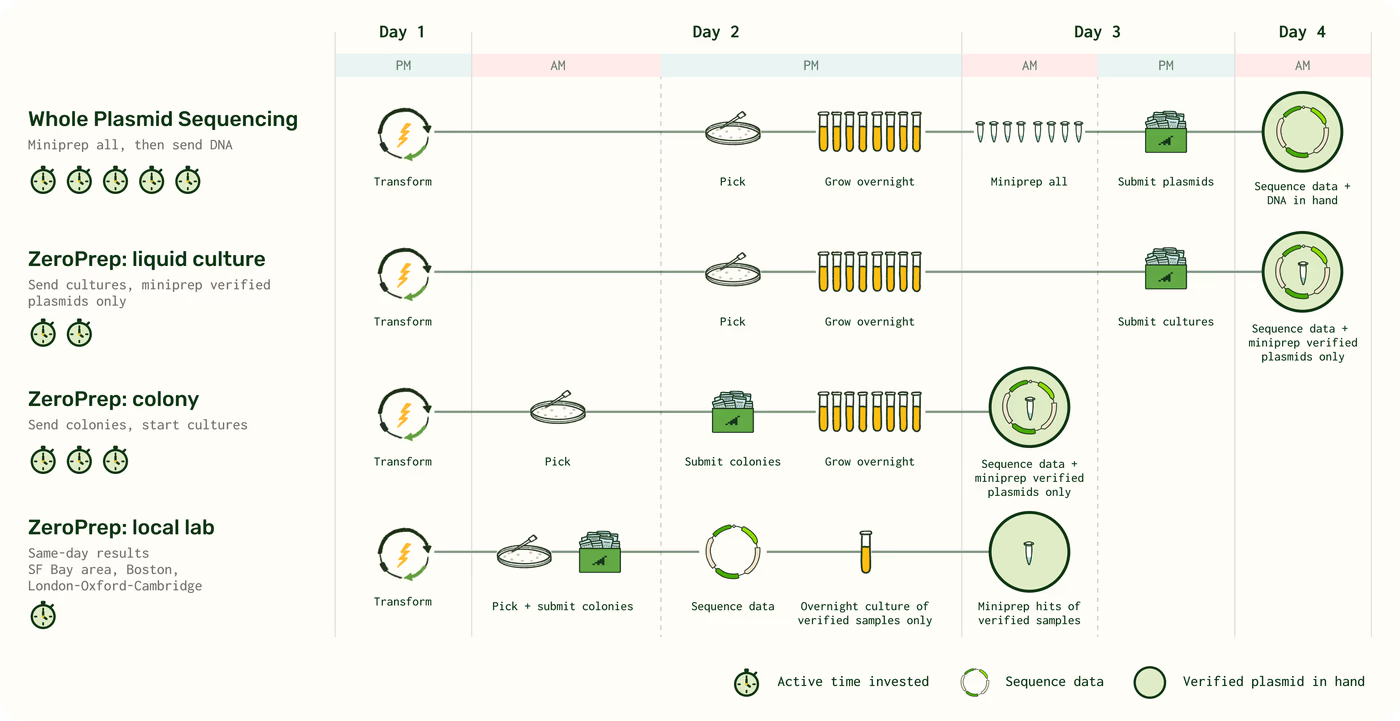
Send liquid cultures instead of DNA. If you already grow overnight cultures, or you're working with low-copy plasmids that sequence more reliably from liquid culture, send us an aliquot of each culture instead of miniprepping them all. Your results arrive on the same schedule as they would with purified DNA, but you skip the hands-on time and reagents spent on clones that turn out to be wrong. When results come in, miniprep only the verified hits from the cultures you kept.
Send colonies and get results a day sooner. For most labs, this is the fastest route. The day after transformation, resuspend each colony in 25 µL of LB medium, use 5 µL to inoculate an overnight culture, and send us the remaining 20 µL for sequencing. By the next morning, you'll know which clones are correct, so you can miniprep only the verified cultures and move forward with your experiment.
Submit at a local dropbox and get results the same day. Our labs in San Francisco, Boston, and London can shrink the wait even further. Resuspend your colonies in the morning and drop them in a participating dropbox. Because your samples don't have far to travel, our dinos can have sequences back to you the same afternoon. That means that you can inoculate only the clones worth keeping and miniprep verified plasmid a day before the standard workflow, with the least hands-on time of any workflow.
Check our Dropbox Locator to find a dropbox near you and see if morning pickups are available. We're constantly expanding our network and adding earlier pickup times, so if you'd like a dropbox at your lab or morning pickups at your favorite location, let us know.
A better way to express
Skipping minipreps for dud clones is only part of the benefit. Getting sequencing results while your overnight cultures are still growing can change the timing of the experiments that follow.
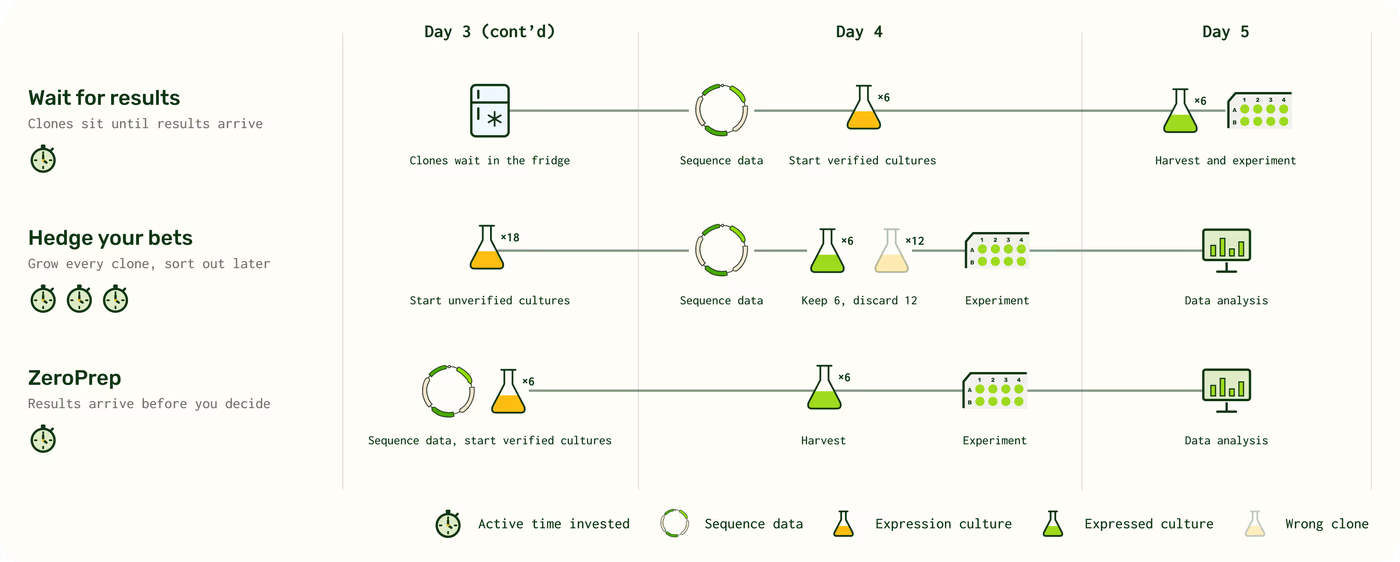
Say you've created six brand-new constructs that you'd like to express. Since cloning can be finicky, it's common practice to pick multiple colonies to sequence before taking the correct clones forward. In a conventional workflow, you have two options: wait for sequencing results before starting expression, refrigerating your overnight cultures in the meantime, or hedge your bets and start expression cultures from multiple candidates, discarding those that don't verify.
Neither option is ideal. Waiting for sequencing results slows your experimental timeline. Even a one-day delay can mean the difference between completing a workflow within a single workweek and carrying it into the next. The “more efficient” alternative, starting expression cultures before verifying your clones, wastes media, incubator space, and hands-on time on constructs you may never use.
With ZeroPrep Colony Sequencing, you don't have to choose. By the time your overnight cultures are ready, you already know which clones are correct. You can move directly into expression, focusing your resources only on verified constructs. For workflows that can be completed in five days, that means potentially going from cloning to finished experiments within a single Monday–Friday workweek.
Faster results, less bias
Most plasmid sequencing workflows need more DNA than a single bacterial colony provides. Some services grow your submitted cells overnight to obtain enough DNA for a conventional miniprep, adding a day of culture time. Others skip the culture step by amplifying plasmid DNA with PCR or rolling circle amplification (RCA). But amplification can distort what you see, hiding the very mutations you're trying to detect. Here's why:
Amplification can misrepresent structural variants. Plasmids can acquire deletions, duplications, and rearrangements during cloning and propagation, and these changes affect how efficiently they amplify. PCR favors shorter products, so deletion variants can outcompete full-length plasmids, while missing or duplicated primer-binding sites can cause variants to disappear or generate unexpected products. A minor variant can appear dominant, or go undetected entirely.
RCA creates a different problem. It converts circular DNA into long, repetitive products, so the length of an amplified molecule no longer directly reflects the length of the original plasmid. This can complicate the identification of plasmid monomers, dimers, and higher-order multimers. RCA-related amplification methods can also favor smaller circles over larger ones, distorting their relative abundance (Norman et al., 2014).
Polymerases struggle with difficult templates. Stable secondary structures can block or stall polymerase progression, while extreme GC content can make DNA strands difficult to separate. GC-rich regions, repeats, and hairpin-forming sequences such as AAV inverted terminal repeats (ITRs) can therefore be difficult to amplify, leaving critical regions underrepresented or missing from the data (Kozarewa et al., 2009; Aird et al., 2011; Petri et al., 2014).
ZeroPrep avoids the trade-offs. Our high-efficiency extraction process recovers enough plasmid DNA directly from your submitted cells for Oxford Nanopore Technologies long-read sequencing, without the need for overnight culture or DNA amplification.
By sequencing native plasmid molecules without amplification, ZeroPrep avoids the preferential enrichment or loss of structural variants that can occur during PCR or RCA. This reduces the risk of overrepresenting deletions, missing variants with disrupted primer-binding sites, underrepresenting larger constructs, or distorting the relative abundance of plasmid monomers and multimers. Long reads can also span difficult regions and reveal how repeats and rearrangements are organized within individual molecules.
The result: plasmid sequences within hours, without amplification-induced distortion of the molecules you're trying to verify.
Keep your experiments moving. Know while you grow.
With ZeroPrep, sequence verification becomes part of the cloning workflow instead of a step that holds everything up. Whether you're skipping unnecessary minipreps, choosing which cultures to take forward, or getting a head start on expression, you have the information you need when it matters.
Because verification should inform your next step, not delay it.
I absolutely love Plasmidsaurus; they are my go-to sequencing company. I was so fed up with other companies losing my samples or delaying my results. But then I found Plasmidsaurus and haven't used anyone else since. I couldn't find a more reliable or affordable service. I know that I will always have my results by early the next morning. Their ZeroPrep service is incredible and legitimately saves me a full day of work. I can't recommend Plasmidsaurus highly enough.
Sean Chapman, UCSD Health
Ready to stop miniprepping the wrong clones?
Try ZeroPrep today and get 3 free samples on your first order with promo code ZEROPREP26.
References
Aird, D. et al. Analyzing and minimizing PCR amplification bias in Illumina sequencing libraries. Genome Biol. 12: R18 (2011). doi: 10.1186/gb-2011-12-2-r18
Kozarewa, I. et al. Amplification-free Illumina sequencing-library preparation facilitates improved mapping and assembly of (G+C)-biased genomes. Nat. Methods 6: 291–295 (2009). doi: 10.1038/nmeth.1311
Norman, A. et al. An improved method for including upper size range plasmids in metamobilomes. PLOS ONE 9: e104405 (2014). doi: 10.1371/journal.pone.0104405
Petri, K. et al. Comparative next-generation sequencing of adeno-associated virus inverted terminal repeats. BioTechniques 56: 269–273 (2014). doi: 10.2144/000114170
Ella Watkins-Dulaney, PhD
Science Writer, Plasmidsaurus
With technical review by:
Shaun Cordes, PhD
Director of Product Management, Plasmidsaurus
Anthony Berndt, PhD
Senior Scientist, Plasmidsaurus
PS-0030-E | v1.0 | Revised Oct. 21, 2026