Bacterial Whole Genome
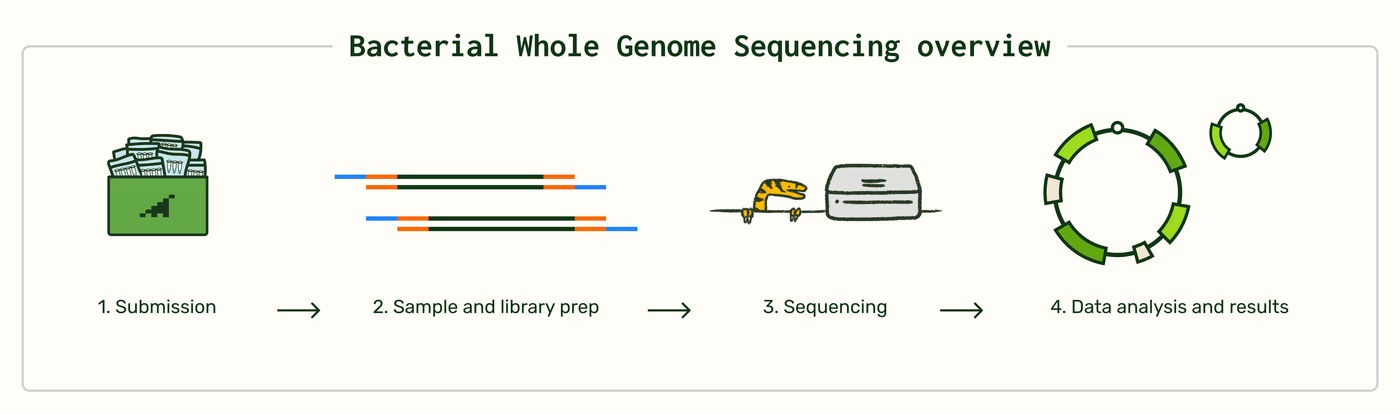
How it works
Plasmidsaurus Bacterial Whole Genome Sequencing uses Oxford Nanopore Technologies (ONT) long-read sequencing to produce de novo assemblies and annotation of reference-quality genomes from clonal populations of bacteria.
An optional Hybrid tier adds Illumina short-read data to polish the assembly for higher per-base accuracy. It is intended for genomes expected to contain many homopolymers or methylated motifs (where systematic Oxford Nanopore errors recur at the same positions and are not resolved by additional long-read coverage), and for assemblies that will serve as a reference for single-nucleotide variant calling. For other applications, such as structural variant analysis, Oxford Nanopore sequencing alone is typically sufficient. Illumina polishing improves per-base accuracy. It does not change the number or topology (circular or linear) of the assembled contigs, which the long-read data determine. It can change contig lengths by a few bases.
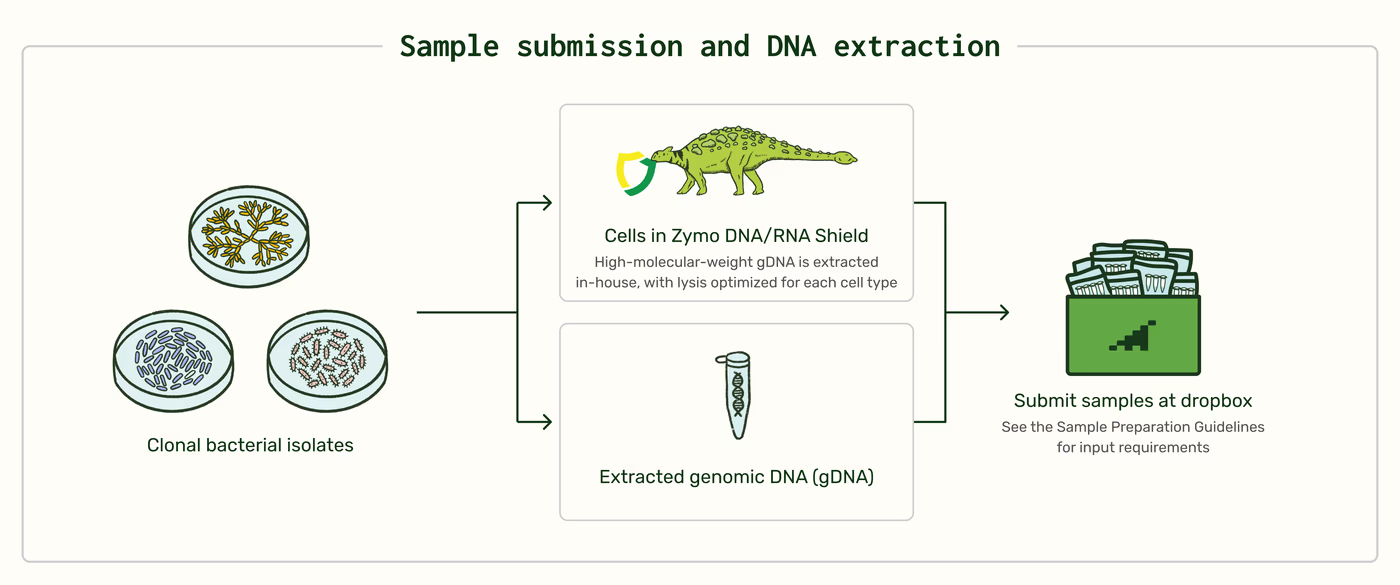
Samples may be submitted either as extracted genomic DNA (gDNA) or as cells preserved in Zymo DNA/RNA Shield. Refer to the Sample Preparation Guidelines for detailed input requirements.
For samples submitted as cells, genomic DNA is extracted using a lysis method appropriate for the cell type that is optimized to reliably generate high-quality de novo assemblies.
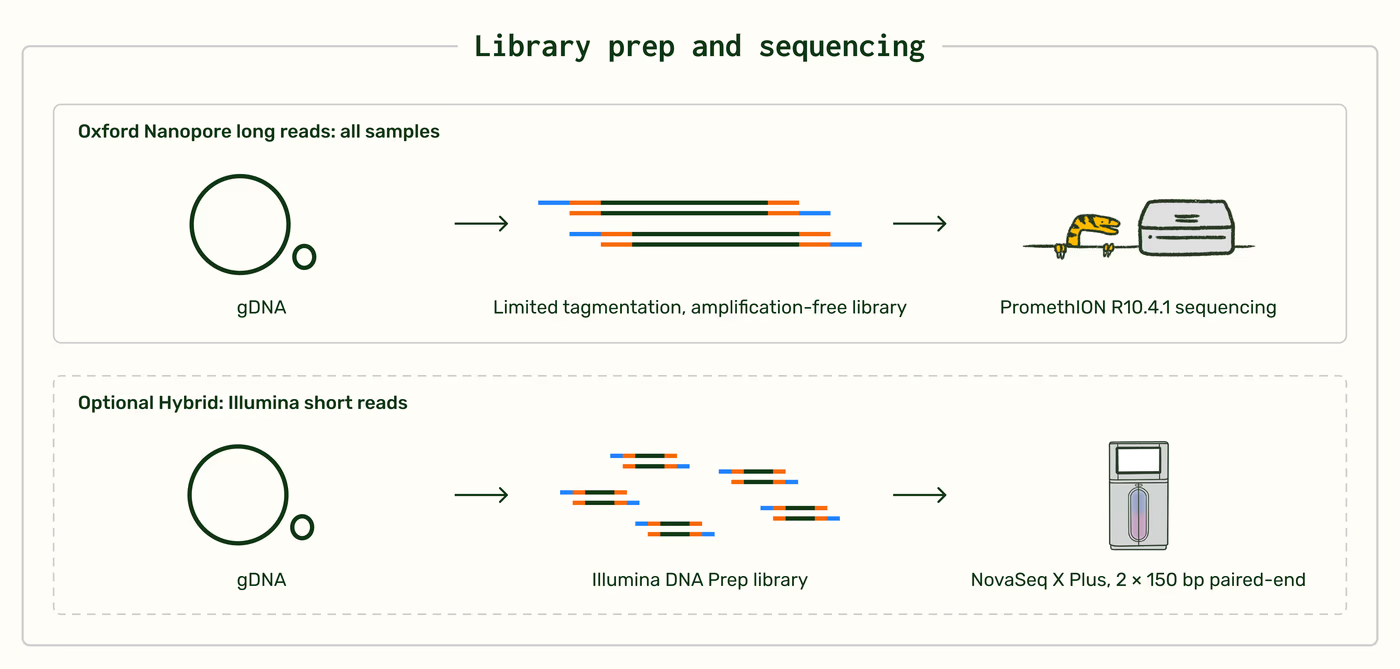
Oxford Nanopore sequencing library preparation: gDNA first undergoes limited, sequence-independent fragmentation via tagmentation, then is built into an amplification-free sequencing library using Oxford Nanopore's v14 chemistry. Libraries are sequenced with a primer-free protocol on Oxford Nanopore PromethION R10.4.1 flow cells. If you require ligation-based ONT library preparation, please contact support about Custom Sequencing.
Hybrid (ONT + Illumina): In addition to ONT sequencing, gDNA libraries are prepared using the Illumina DNA Prep Kit and sequenced on the Illumina NovaSeq X Plus platform (catalog no. 20084804). The paired-end short reads (2 × 150 bp) are used downstream to polish the long-read assembly, improving nucleotide-level accuracy in regions prone to long-read errors, such as homopolymers and methylated motifs.
Bioinformatics
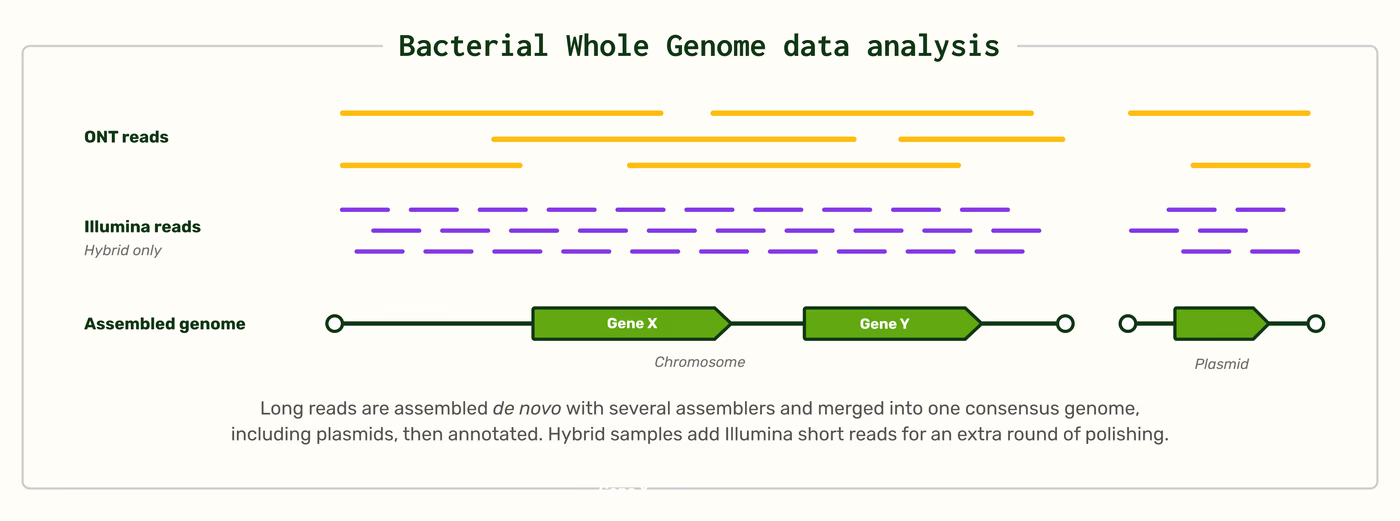
We filter the raw Oxford Nanopore reads for quality and use them to estimate the genome size. Several assemblers then assemble the reads, and Autocycler combines their results into one consensus assembly. The consensus assembly keeps the sequence that most assemblies agree on, so we do not run a separate long-read polishing step. The assembly is then annotated and analyzed for contamination and species identification.
For samples with the Hybrid (ONT + Illumina) option, we polish the assembly with aligned Illumina short reads.
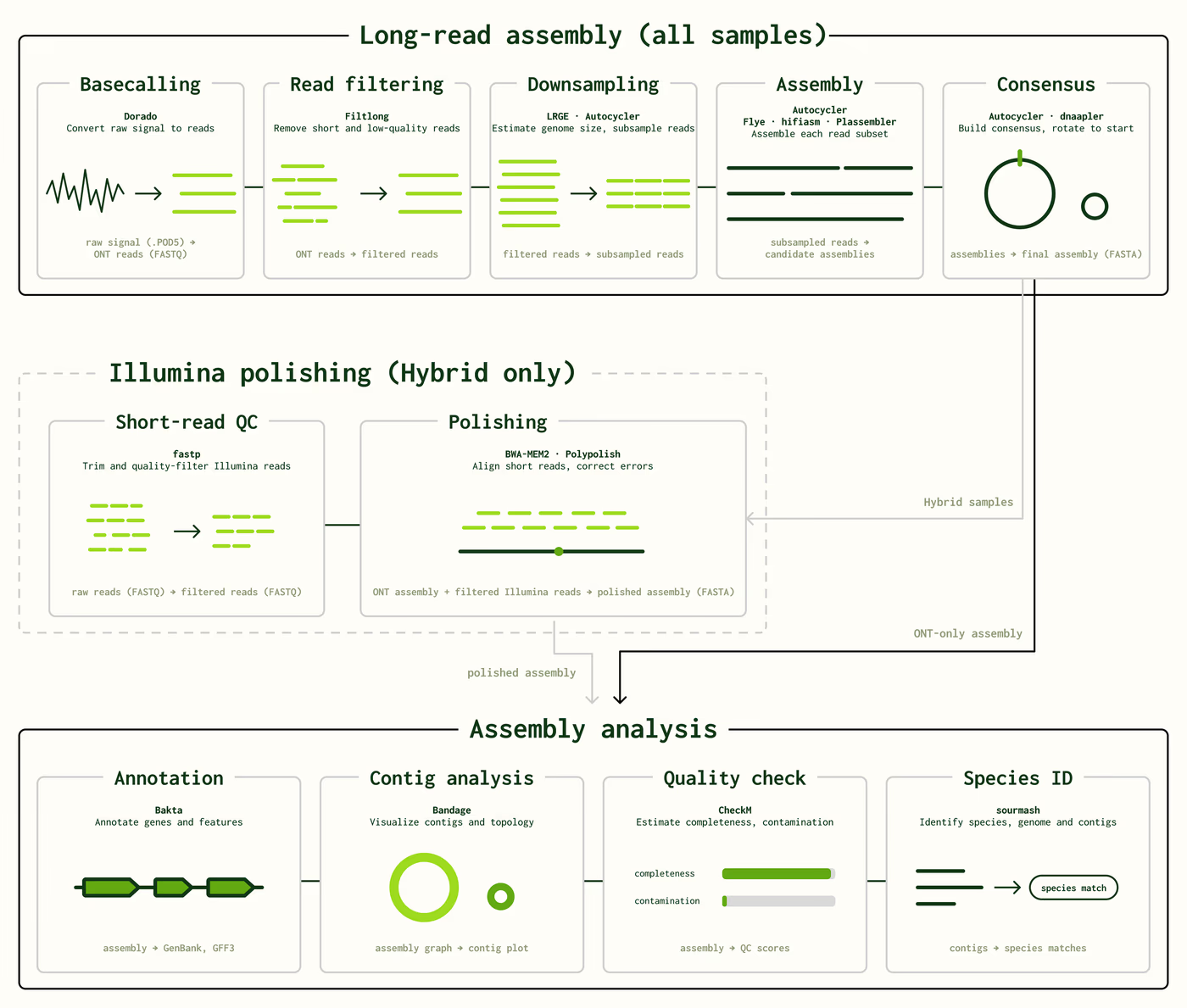
Detailed bioinformatics methods below.
| Step | Substep | Software | Method and parameters |
|---|---|---|---|
| Basecalling | — | Dorado | Performs Super Accurate basecalling with default Q10 quality filtering. |
| Quality filtering | — | Filtlong | Removes reads shorter than 300 bp. Then keeps the best 95% of the bases, ranked mostly by read quality. |
| Genome size estimation | — | LRGE; Raven | Estimates the genome size from the filtered reads. If the estimate looks unreliable, the size of a Raven assembly is used instead. |
| Downsampling | Coverage cap Read subsets | Filtlong; in-house read classifier; Autocycler | Keeps the longest, highest-quality reads, up to about 100× coverage of the estimated genome size. This can drop the short reads of small plasmids. When the reads are long enough (read N50 of at least 2 kb), an in-house read classifier finds these plasmid reads and adds a capped number back. Splits the reads into 2 read subsets with at least 25× coverage each, or at least 20× when there are fewer reads. Below 20× coverage, or when the read N50 is below 2 kb, all reads go to assembly as one set. Samples below 10× coverage are not assembled. |
| Assembly | Candidate assembly generation | Autocycler; Flye; Raven; miniasm; Minipolish; Myloasm; metaMDBG; hifiasm; Plassembler | Autocycler runs six assemblers on each read subset: Flye, Raven, miniasm (polished with Minipolish), Myloasm, metaMDBG, and Plassembler, which finds and assembles plasmids. When all reads go to assembly as one set, Autocycler runs three assemblers: Flye, hifiasm, and Plassembler. |
| Consensus assembly | Autocycler | Removes contigs with very low coverage from each candidate assembly. Then compresses, clusters, trims, and resolves the candidate assemblies, and combines them into one consensus assembly. If the reads were split into read subsets and the consensus assembly looks incomplete, for example the chromosome is not closed, Flye and hifiasm also assemble all the reads. We may then rebuild the consensus assembly in up to three ways, and we keep the version that best matches the reads and has the largest contig. | |
| Assembly rotation | dnaapler | Rotates each circular contig to begin at a standard start gene when it finds one: dnaA for the chromosome, repA for plasmids. Then removes contigs shorter than 1 kb. | |
| Analysis | Genome annotation | Bakta | Annotates the assembled genome. |
| Contig analysis | Bandage | Analyzes contigs and assembly structure. | |
| Completeness and contamination assessment | CheckM | Evaluates genome completeness and contamination. | |
| Species and plasmid identification | sourmash | Compares assembled sequences against a custom database containing GTDB release 226, RefSeq plasmids, and phage sequences. | |
| Variant calling | Input reads | Filtlong | Uses the same filtered reads as the assembly: up to about 100× coverage from Filtlong, plus any plasmid reads added back. |
| Read alignment | minimap2 | Aligns filtered Oxford Nanopore reads to the customer-provided reference genome. | |
| Small variant calling | Clair3 | Calls single-nucleotide variants and small insertions and deletions using a bacteria-tuned model. Calls structural variants of 50 bp or more, such as insertions, deletions, duplications, and inversions, from the same alignment. Runs in mosaic mode to also find variants present in only some of the reads. | |
| Structural variant calling | Sniffles2 | ||
| Variant filtering | GATK | Removes small variant calls with a QUAL score under 10 or fewer than 10 supporting reads. Also removes clusters of 3 or more variants within 30 bp, a common nanopore error pattern. Reports a QUAL score for each kept variant. | |
| Variant annotation | SnpEff | Annotates variants and predicts their effects when the customer-provided reference genome includes annotations. | |
| Optional Hybrid analysis (ONT + Illumina) Before annotation, species identification, and genome alignment | Short-read quality control | fastp | Processes Illumina reads using a minimum Phred quality score of 15 and a minimum retained length of 50 bp. Trims adapters, poly(G) tails, and low-quality bases at the 3′ end of each read. |
| Short-read alignment | BWA-MEM2 | Aligns quality-controlled short reads to the long-read assembly. | |
| Assembly polishing | Polypolish | Polishes the long-read assembly using the aligned Illumina reads. Uses --careful mode when the long-read coverage is under 25×. This produces a new polished hybrid assembly in FASTA format. |
Notes: QUAL is a Phred-scaled confidence score calculated as −10 log₁₀(P), where P is the probability that the variant call is incorrect. For example, QUAL 20 corresponds to a 1% probability that the call is incorrect. This pipeline is optimized for identifying variants in bacterial isolates and is not intended to estimate allele fractions in mixed populations.
Data and deliverables
Filename key
ORDERCODEUnique order identifier, such as
JPY6QT.OSIDOrder-sample identifier, such as
JPY6QT_1, used to trace files back to a specific tube.SAMPLECustomer-provided sample name, such as
Control_rep_1. Used with the OSID in filenames like<OSID>_<SAMPLE>.
Download Results button <ORDERCODE>_results.zip
Results generated from the automated data analysis pipeline.
| File or deliverable | Description |
|---|---|
<OSID>_<SAMPLE>_report.html | A standalone HTML report for the sample. It has the same summary numbers and charts as the online results page, saved as a file you can keep or share. |
<OSID>_<SAMPLE>/<OSID>_<SAMPLE>_ont-stats.tsv | Basic stats on your raw sequencing reads: total reads, total bases, longest and median read length, and read N10 to N90. It also lists the assembled genome size, the estimated coverage before and after downsampling, and the median read quality and read NG50 of the reads used for assembly. |
<OSID>_<SAMPLE>/<OSID>_<SAMPLE>_reads.png | A plot showing the length and quality of your sequencing reads. |
<OSID>_<SAMPLE>/<OSID>_<SAMPLE>_ont-contigs.png | A picture of the assembly graph, drawn by Bandage. Each contig (a continuous stretch of assembled DNA sequence) is drawn by length and colored by coverage. A complete circular contig shows as a closed loop. We draw it before the final contig cleanup, so it can show small contigs that are not in the final FASTA. |
<OSID>_<SAMPLE>/<OSID>_<SAMPLE>_ont-contigs.txt | Summary stats of the assembly graph from Bandage: number of contigs and connections, total length, N50, shortest and longest contig, and median coverage. Like the picture above, these stats come from before the final contig cleanup. |
<OSID>_<SAMPLE>/<OSID>_<SAMPLE>_checkm-plot.png | A plot from CheckM that shows where its marker genes sit on each contig. CheckM uses the presence and counts of these single-copy housekeeping genes to estimate how complete and how contaminated your genome assembly is. The image is blank when CheckM cannot draw it. |
<OSID>_<SAMPLE>/<OSID>_<SAMPLE>_checkm-results.tsv | The CheckM completeness and contamination scores in table form. |
<OSID>_<SAMPLE>/<OSID>_<SAMPLE>_sourmash-genome-species.csv | The species identification for your whole assembled genome, based on comparing it to a reference database. |
<OSID>_<SAMPLE>/<OSID>_<SAMPLE>_sourmash-contigs-species.csv | The species identification for each contig individually. This helps flag contamination if one contig does not match the species of the rest. |
<OSID>_<SAMPLE>/<OSID>_<SAMPLE>_prepolished-assembly-info.yaml | A summary of the consensus assembly from Autocycler: total length, number of contigs, whether every contig resolved into one clean sequence, and the length, topology, and coverage of each contig. It comes from before rotation and the final contig cleanup, so it can list contigs that are not in the final FASTA. |
<OSID>_<SAMPLE>/<OSID>_<SAMPLE>_1_circos.png | A circular map of your assembled genome from Bakta. It shows all contigs with annotated features, GC content, and GC skew. |
<OSID>_<SAMPLE>/<OSID>_<SAMPLE>_1_reference.fasta | The assembled genome sequence itself, in FASTA format; this is the actual DNA sequence with no annotations. |
<OSID>_<SAMPLE>/<OSID>_<SAMPLE>_1_reference.gbk | The assembled genome with gene annotations included, in GenBank format. Compatible with SnapGene, Geneious, and similar tools. |
<OSID>_<SAMPLE>/annotation/<OSID>_<SAMPLE>_1_reference.* | The full gene annotation output from the Bakta annotation package, in every common format (GFF3, EMBL, protein and gene FASTA files, a full JSON file, a short text summary, and more) for anyone who wants annotation data beyond what's in the GenBank file. |
Hybrid (ONT + Illumina) deliverables
Samples sequenced with the Hybrid option receive the files above plus the following. The polished files are the final assembly for hybrid samples.
| File or deliverable | Description |
|---|---|
<OSID>_<SAMPLE>/<OSID>_<SAMPLE>_1_polished-reference.fasta | The final hybrid assembly sequence in FASTA format: the long-read assembly after polishing with Illumina short reads. If the long-read assembly was already highly accurate, polishing may make few or no changes. |
<OSID>_<SAMPLE>/<OSID>_<SAMPLE>_1_polished-reference.gbk | The final hybrid assembly with gene annotations, in GenBank format. Compatible with SnapGene, Geneious, and similar tools. |
<OSID>_<SAMPLE>/<OSID>_<SAMPLE>_1_polished-circos.png | A circular map of the polished assembly, showing all contigs with GC skew and feature locations. |
<OSID>_<SAMPLE>/<OSID>_<SAMPLE>_1_polished-stats.txt | A position-by-position record of the polishing step, showing the short-read depth and base calls at every position and whether each base was kept or changed. This is a large file, typically over 100 MB. |
<OSID>_<SAMPLE>/<OSID>_<SAMPLE>_QC-short-reads.html | A quality report for the Illumina reads, generated by fastp: read counts, quality scores, adapter content, and how many reads passed filtering. |
<OSID>_<SAMPLE>/annotation/<OSID>_<SAMPLE>_1_polished-reference.* | The full Bakta annotation output for the polished assembly. These files sit in the same annotation folder as the standard files, in the same formats. |
FASTQ button <ORDERCODE>_fastq.zip
| File or deliverable | Description |
|---|---|
<OSID>_<SAMPLE>.fastq.gz | The raw sequencing reads, unfiltered and exactly as they came off the sequencer. |
Online results page
| File or deliverable | Description |
|---|---|
| Summary stats | Coverage, total sequence generated, read N50, median quality score, genome size, assembled coverage, CheckM completeness and contamination percentages, and number of genes annotated. |
| Interactive assembly viewer | A zoomable map of your assembled contigs, letting you browse annotated genes, amino acid sequences, and the raw DNA sequence directly in the browser. |
| Contig table | Lists each contig with its length, whether it's circular or linear, the species match, and percent identity (ANI) to that species. |
| Variant calling tab | Enables the comparison of your assembly against a reference genome you upload, to see differences (variants) between the two. |
| Reference Manager | Lets you upload a GenBank, FASTA, or SnapGene file to compare against your results, either for annotation reference or variant calling. |
| View Report link | Opens the same HTML report that's included in the Download Results zip. |
Technical notes and related guides
Performance and troubleshooting
If coverage is sufficient, we typically see assembled contigs with ~Q60 (99.9999%) accuracy.
Reruns
Whole Genome Sequencing outcomes depend heavily on the quantity, quality, and purity of the submitted sample. For this reason, Plasmidsaurus does not guarantee that every sample will meet the target raw-data yield or produce a high-quality, high-coverage genome assembly.
When a sample does not meet the applicable performance criteria, we review the initial sequencing results to determine whether additional sequencing is likely to improve the outcome. Eligible samples are automatically queued for one complimentary rerun, which may include protocol adjustments. Data from the initial run and rerun are combined for downstream assembly and analysis.
Samples that produce neither the target amount of raw sequencing data nor a consensus sequence are automatically queued for a complimentary rerun.
Additional sequencing attempts
If the target data yield or an acceptable assembly is not achieved after the complimentary rerun, no further complimentary reruns will be performed. Charges still apply to unsuccessful samples because library preparation, sequencing, analysis, and additional review have already been completed.
To attempt sequencing again, submit a new sample that meets all applicable sample preparation and quality-control requirements and place a new sequencing order.