Yeast Whole Genome
How it works
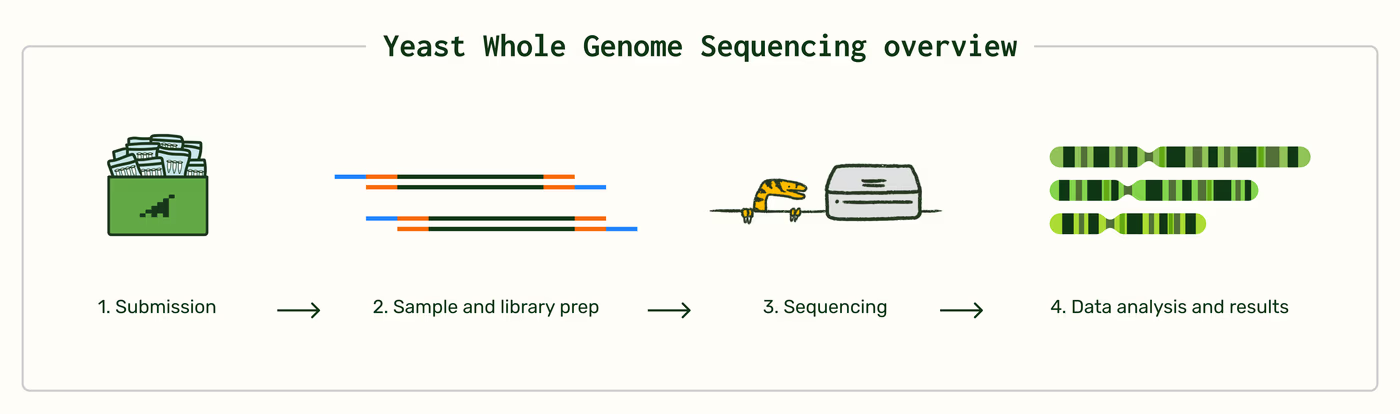
Plasmidsaurus Yeast Whole Genome Sequencing uses Oxford Nanopore long-read sequencing to produce de novo assemblies and annotation of reference-quality genomes from clonal populations of yeast.
An optional Hybrid tier adds Illumina short-read data to polish the assembly for higher per-base accuracy. It is intended for genomes expected to contain many homopolymers or methylated motifs (where systematic Oxford Nanopore errors recur at the same positions and are not resolved by additional long-read coverage), and for assemblies that will serve as a reference for single-nucleotide variant calling. For other applications, such as structural variant analysis, Oxford Nanopore sequencing alone is typically sufficient. Illumina polishing improves per-base accuracy but does not change the number, size, or topology of assembled contigs, which are determined entirely by the long-read data.
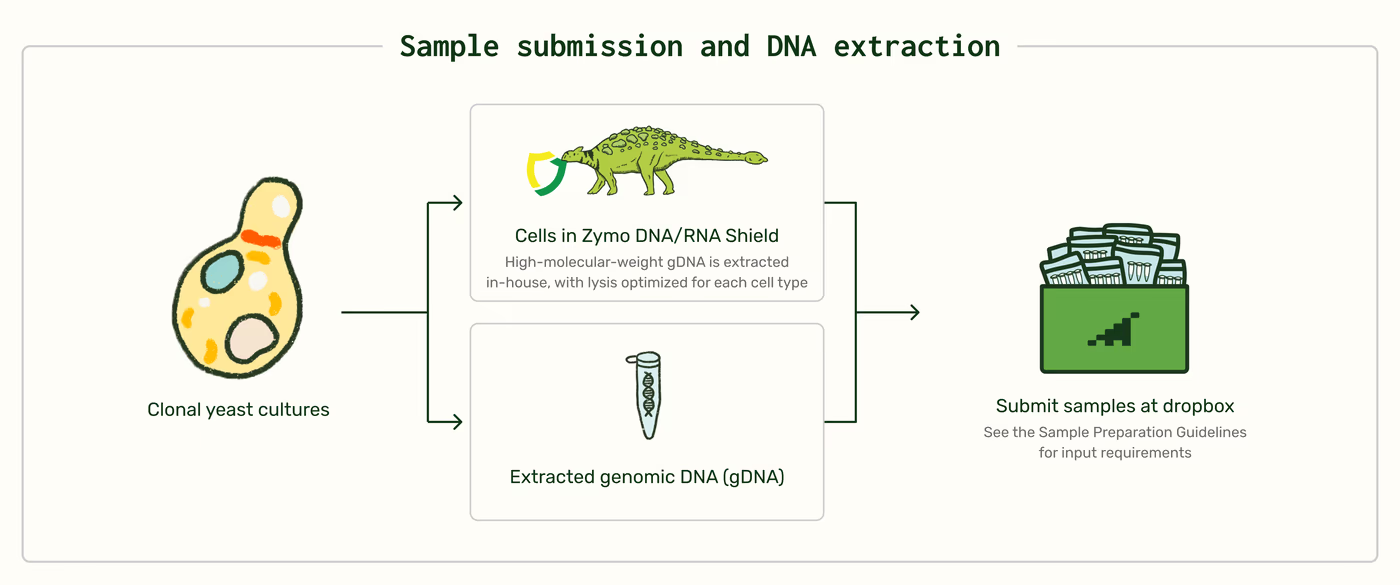
Samples may be submitted either as extracted genomic DNA (gDNA) or as cells preserved in Zymo DNA/RNA Shield. Refer to the Sample Preparation Guidelines for detailed input requirements.
For samples submitted as cells, genomic DNA is extracted using a lysis method appropriate for the cell-type that is optimized to reliably generate high-quality de novo assemblies. Review the Sample Preparation Guidelines to confirm that your species is on our approved list.
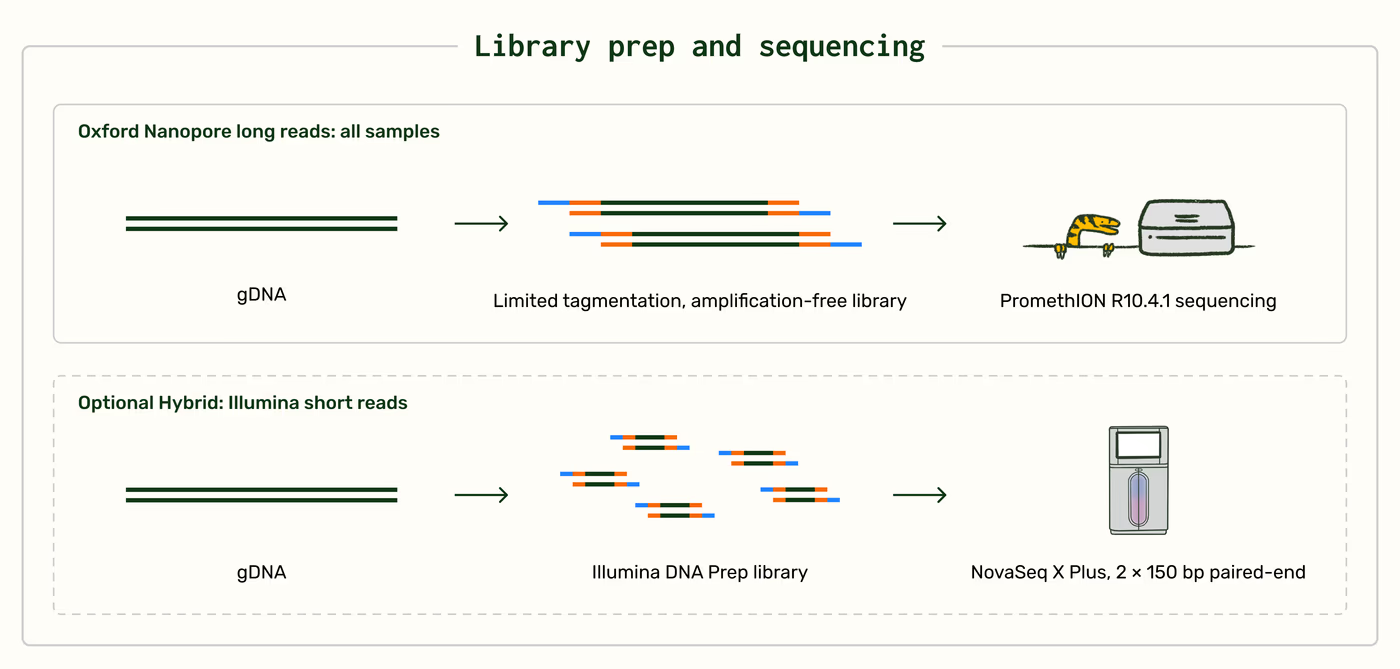
Oxford Nanopore sequencing library preparation: gDNA first undergoes limited, sequence-independent fragmentation via tagmentation, then is built into an amplification-free sequencing library using Oxford Nanopore's v14 chemistry. Libraries are sequenced with a primer-free protocol on Oxford Nanopore PromethION R10.4.1 flow cells. If you require ligation-based ONT library preparation, please contact support for custom projects.
Hybrid ONT + Illumina: In addition to ONT sequencing, gDNA libraries are prepared using the Illumina DNA Prep Kit and sequenced on the Illumina NovaSeq X Plus platform (catalog no. 20084804). The paired-end short reads (2 × 150 bp) are used downstream to polish the long-read assembly, improving nucleotide-level accuracy in regions prone to long-read errors, such as homopolymers and methylated motifs.
Bioinformatics
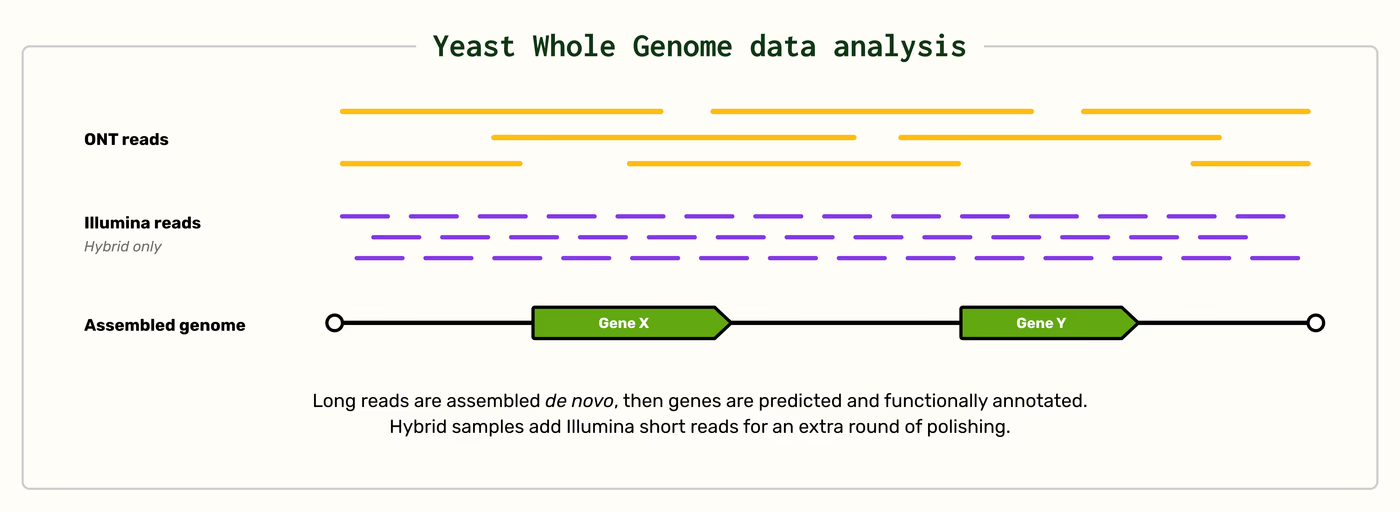
Oxford Nanopore raw reads are quality filtered and assembled de novo. Genes are then predicted and functionally annotated, and the assembly is evaluated for completeness.
Samples submitted with the Hybrid (ONT + Illumina) option undergo an additional round of polishing using aligned short-read data.
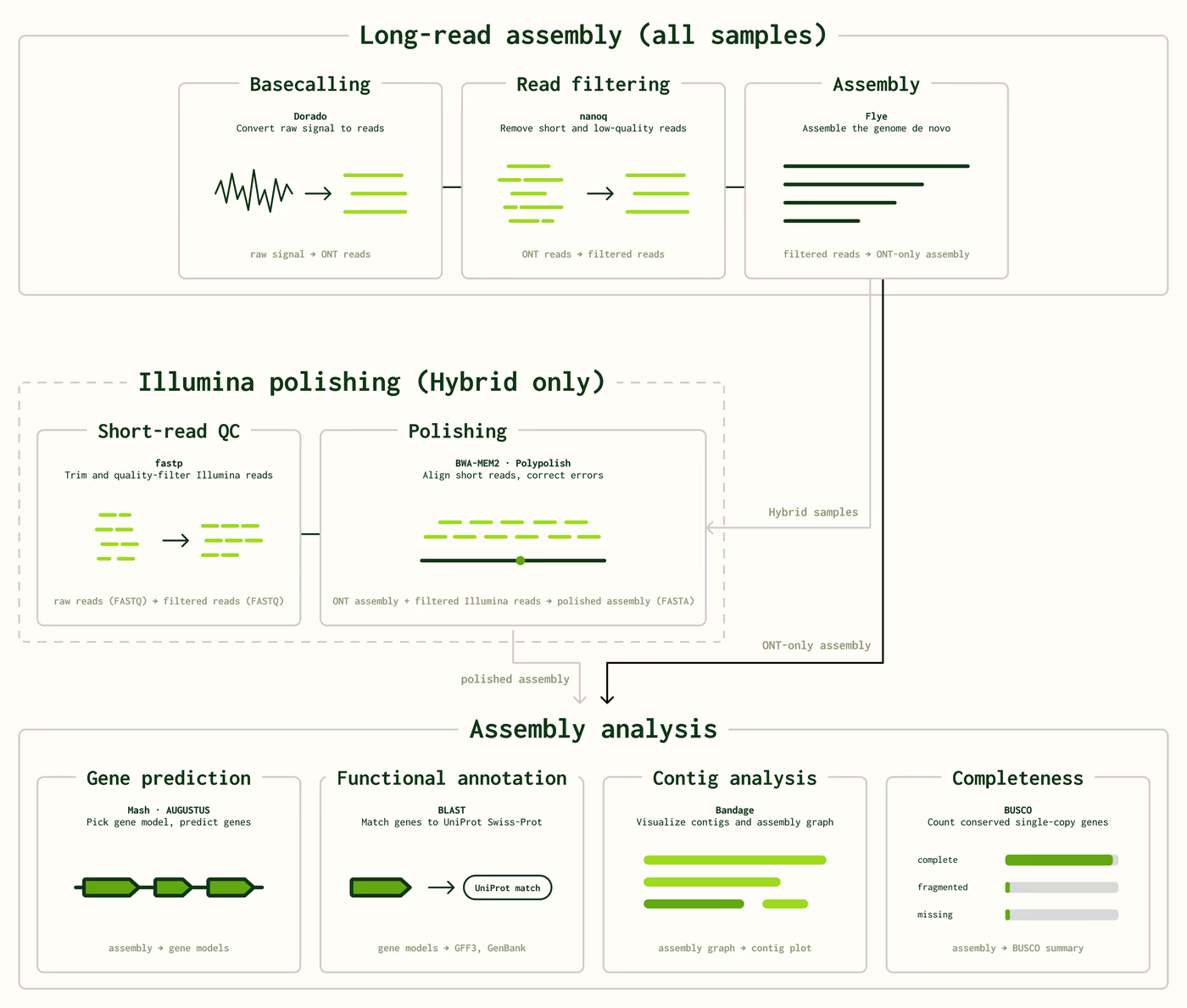
Detailed bioinformatics methods below.
| Step | Substep | Software | Method and parameters |
|---|---|---|---|
| Basecalling | — | Dorado | Performs Super Accurate basecalling with default Q10 quality filtering. |
| Quality filtering | — | nanoq | Removes reads with quality scores below 10 or lengths below 400 bp. |
| Assembly | — | Flye | Generates a de novo assembly using parameters optimized for high-quality Oxford Nanopore reads. |
| Analysis | Gene prediction | AUGUSTUS | Predicts genes using the gene model automatically selected (via Mash-based species identification) from the closest supported reference species. |
| Functional annotation | BLAST | Aligns predicted open reading frames against UniProt Swiss-Prot release 2024_04*. A match is retained only when the E-value is below 0.05 and percent identity is above 50%. | |
| Contig analysis | Bandage | Analyzes contigs and assembly structure. | |
| Completeness and contamination assessment | BUSCO | Evaluates genome completeness using conserved single-copy orthologs. For hybrid samples, BUSCO runs on the long-read assembly before polishing. | |
| Optional Hybrid analysis (ONT + Illumina) | Short-read quality control | fastp | Processes Illumina reads using a minimum Phred quality score of 15 and minimum retained length of 50 bp. Adapter and poly(G) sequences are trimmed. |
| Short-read alignment | BWA-MEM2 | Aligns quality-controlled short reads to the long-read assembly. | |
| Assembly polishing | Polypolish | Polishes the long-read assembly using the aligned Illumina reads. Uses --careful mode when coverage is <25x This produces a new .fasta polished hybrid assembly file |
Data and deliverables
Filename key
ORDERCODEUnique order identifier, such as
JPY6QT.OSIDOrder-sample identifier, such as
JPY6QT_1, used to trace files back to a specific tube.SAMPLECustomer-provided sample name, such as
Control_rep_1. Used with the OSID in filenames like<OSID>_<SAMPLE>.
Download Results button <ORDERCODE>_results.zip
Results generated from the automated data analysis pipeline.
| File or deliverable | Description |
|---|---|
<OSID>_<SAMPLE>_report.html | A standalone HTML report for the sample. It has the same summary numbers and charts as the online results page, saved as a file you can keep or share. |
<OSID>_<SAMPLE>/<OSID>_<SAMPLE>_busco-short-summary.txt | The BUSCO completeness result as plain text: counts of conserved single-copy orthologs found complete (single-copy or duplicated), fragmented, or missing, out of the total searched, along with the lineage dataset used, assembly statistics for the contigs, and the tool versions BUSCO ran with. |
<OSID>_<SAMPLE>/<OSID>_<SAMPLE>_1_reference.fasta | The assembled genome sequence itself, in FASTA format — this is the actual DNA sequence with no annotations. |
<OSID>_<SAMPLE>/<OSID>_<SAMPLE>_1_reference.gff | The assembled genome's gene annotations in GFF3 format. |
<OSID>_<SAMPLE>/<OSID>_<SAMPLE>_1_reference.gbk | The assembled genome with gene annotations included, in GenBank format. Compatible with SnapGene, Geneious, and similar tools. |
<OSID>_<SAMPLE>/<OSID>_<SAMPLE>_ont-stats.tsv | Basic stats on your raw sequencing reads: average and median read length, N50, and read count. |
<OSID>_<SAMPLE>/<OSID>_<SAMPLE>_ont-contigs.png | A plot showing the size and coverage of each assembled contig. |
<OSID>_<SAMPLE>/<OSID>_<SAMPLE>_ont-contigs.txt | A plain-text list of the assembled contigs, with length and coverage. |
<OSID>_<SAMPLE>/<OSID>_<SAMPLE>_reads.png | A plot showing the length and quality distribution of your reads. |
Hybrid (ONT + Illumina) deliverables
Samples sequenced with the Hybrid option receive the files above plus the following. The polished files are the final assembly for hybrid samples.
| File or deliverable | Description |
|---|---|
<OSID>_<SAMPLE>/<OSID>_<SAMPLE>_1_polished-reference.fasta | The final hybrid assembly sequence in FASTA format: the long-read assembly after polishing with Illumina short reads. If the long-read assembly was already highly accurate, polishing may make few or no changes. |
<OSID>_<SAMPLE>/<OSID>_<SAMPLE>_1_polished-reference.gbk | The final hybrid assembly with gene annotations, in GenBank format. Compatible with SnapGene, Geneious, and similar tools. |
<OSID>_<SAMPLE>/<OSID>_<SAMPLE>_1_polished-stats.txt | A position-by-position record of the polishing step, showing the short-read depth and base calls at every position and whether each base was kept or changed. This is a large file, typically over 100 MB. |
<OSID>_<SAMPLE>/<OSID>_<SAMPLE>_QC-short-reads.html | A quality report for the Illumina reads, generated by fastp: read counts, quality scores, adapter content, and how many reads passed filtering. |
<OSID>_<SAMPLE>/<OSID>_<SAMPLE>_1_polished-reference.gff | The polished assembly’s gene annotations in GFF3 format. |
<OSID>_<SAMPLE>_busco-short-summary.txt | For hybrid samples, these counts describe the long-read assembly before polishing. |
FASTQ button <ORDERCODE>_fastq.zip
| File or deliverable | Description |
|---|---|
<OSID>_<SAMPLE>.fastq.gz | The raw sequencing reads for the sample, before quality filtering. |
Online results page
| File or deliverable | Description |
|---|---|
| Results by sample | Per-sample cards showing total reads, coverage, and assembly size (Mbp), each with a “View Report” link to the same standalone HTML report. |
Technical notes and related guides
Performance and troubleshooting
If coverage is sufficient, we typically see assembled contigs with ~Q60 (99.9999%) accuracy.
Reruns
Whole Genome Sequencing outcomes depend heavily on the quantity, quality, and purity of the submitted sample. For this reason, Plasmidsaurus does not guarantee that every sample will meet the target raw-data yield or produce a high-quality, high-coverage genome assembly.
When a sample does not meet the applicable performance criteria, we review the initial sequencing results to determine whether additional sequencing is likely to improve the outcome. Eligible samples are automatically queued for one complimentary rerun, which may include protocol adjustments. Data from the initial run and rerun are combined for downstream assembly and analysis.
Samples that produce neither the target amount of raw sequencing data nor a consensus sequence are automatically queued for a complimentary rerun.
Additional sequencing attempts
If the target data yield or an acceptable assembly is not achieved after the complimentary rerun, no further complimentary reruns will be performed. Charges still apply to unsuccessful samples because library preparation, sequencing, analysis, and additional review have already been completed.
To attempt sequencing again, submit a new sample that meets all applicable sample preparation and quality-control requirements and place a new sequencing order.