
From sample drop-off to automated analysis, here’s the system behind our ultrafast RNA-Seq results.
RNA-Seq has long been one of biology’s most powerful tools, revealing hidden pathways, unexpected biology, and the molecular stories unfolding inside cells. But for many researchers, routine RNA-Seq has remained out of reach because of three persistent barriers: time, cost, and analysis.
Plasmidsaurus RNA-Seq was built to change that. With results in 3 days, pricing that makes replicates practical ($50/sample for academic users, $80/sample for commercial users), and automated analysis built into the experience, Plasmidsaurus brings transcriptome-wide discovery in line with the pace of everyday research.
Making RNA-Seq faster and more affordable required more than optimizing a single step. It meant designing the entire service around the realities of what scientists actually need. Every fast turnaround depends on a thoughtfully engineered system of logistics, automation, sequencing, and analysis. Here’s a closer look at the journey each sample takes through Plasmidsaurus RNA-Seq, from dropbox to data.
The dinosaur delivery network
Shipping may not be the first thing that comes to mind when you think about a sequencing company, but it’s essential to the Plasmidsaurus experience. From the customer side, the process is simple: drop off your sample, hang tight as we Sequence Everything, get your data, and keep moving forward. Behind that experience is a coordinated logistics network spanning 1,400+ dropboxes and 10 labs worldwide.
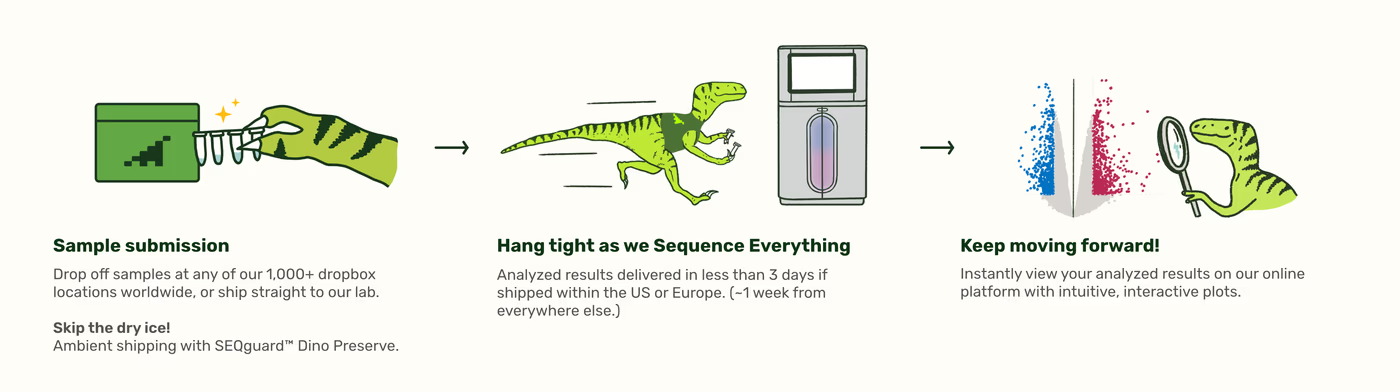
A sample’s journey begins at one of Plasmidsaurus’ dropbox locations, where a local courier collects it and routes it to the appropriate sequencing lab. For RNA-Seq, that means one of two dedicated sequencing hubs: Louisville or Cologne. These locations were chosen to support rapid service across the U.S. and Europe, with each lab positioned near major transportation and shipping infrastructure to reduce transit time.
Moving thousands of samples through the Plasmidsaurus network every day takes an operations team focused on the details. “A sequencing service is only as fast as its slowest step, so every handoff matters,” says Jenni DeSelm, Plasmidsaurus Vice President of Operations. “The R&D team can work very hard to shave 30 minutes off a workflow, but a one-day shipping delay can erase those gains instantly.” She and her team refine pickup schedules, identify locations for new dropboxes, balance capacity across labs, and optimize shipping routes in a constantly changing global logistics landscape.
Automation built for scale
Once samples reach our sequencing facilities, automation takes center stage. Technicians unpack incoming samples, take a moment to admire the dino drawings that arrive with them, and load the samples onto Opentrons liquid handling robots.
Rather than building our workflows around massive, expensive automation platforms, we chose Opentrons liquid handling robots because they are flexible, affordable, and easy to adapt. This allows us to scale automation across labs without locking ourselves into unnecessary infrastructure costs, helping us keep sequencing affordable for customers.
But flexible automation is only powerful when it’s expertly directed. At Plasmidsaurus, that work is led by Andrey Shur and Erik Werner. They choreograph the precise robotic liquid handling steps that make high-throughput sample preparation possible. They also design custom 3D-printed parts that reimagine what is possible with conventional lab automation tools.
Designing those parts to be 3D-printable adds another advantage: improvements can scale globally almost instantly. When the team develops a better part, they don’t have to wait for manufacturing runs or international shipping. The same design can be printed on-site at Plasmidsaurus labs around the world, allowing workflow upgrades to roll out across facilities at the same time.
Molecular biology designed for efficiency
While logistics and automation account for much of the speed and savings, the service also depends on a molecular biology workflow designed for efficient, high-quality gene expression analysis.
After evaluating RNA-Seq methods for performance, cost, scalability, and statistical power, the Plasmidsaurus R&D team chose 3′ end counting as the foundation for the service. The approach captures the gene-expression signal researchers care about while making RNA-Seq easier to automate and scale. By adding sample-specific barcodes early, samples can be pooled sooner, reducing handling and enabling a faster, more streamlined workflow than fragmentation-based RNA-Seq.
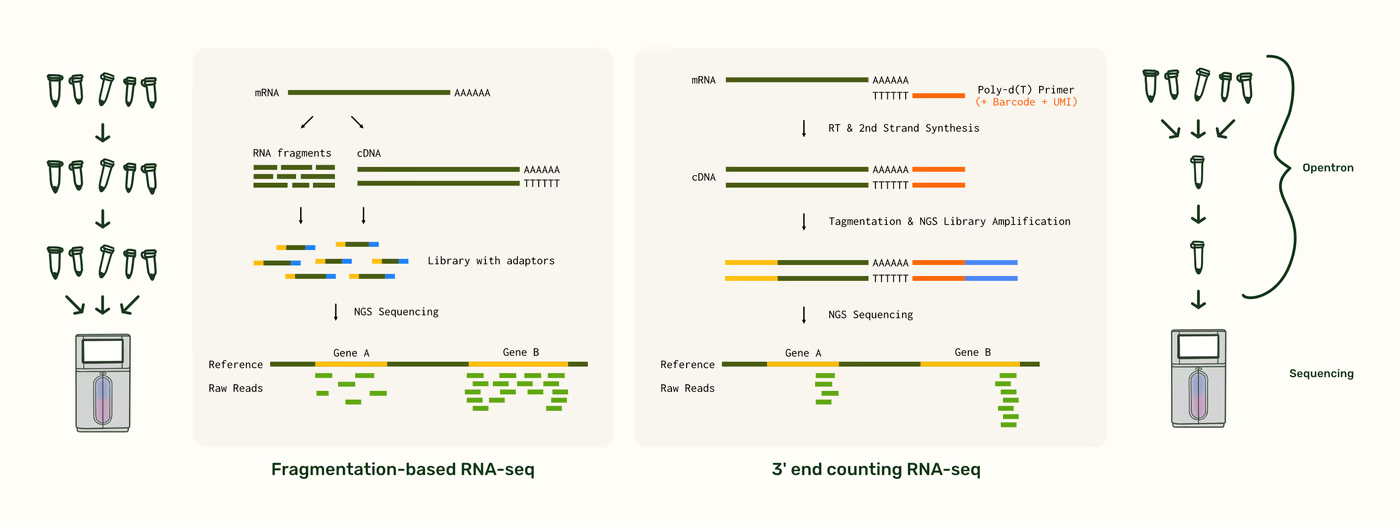
For a deeper look at the performance, read our whitepaper comparing Plasmidsaurus RNA-Seq with fragmentation-based RNA-Seq for gene-level expression analysis.
Analysis without the bottleneck
Finally, fast sequencing only changes the game if researchers can make sense of the data just as quickly. For years, RNA-Seq adoption has been slowed not only by long turnaround times, but by the analysis bottleneck that comes afterward. For many scientists, the prospect of wrestling with code is enough to send a transcriptomics experiment straight to the back burner.
So we built more than a fast RNA-Seq service. Our bioinformatics team created a streamlined data analysis pipeline that processes data as soon as it comes off the sequencers, turning raw reads into interpretable results without the usual delay.
The pipeline uses methods that are well supported in the RNA-Seq literature and appropriate for count-based differential expression analysis. Rather than reinventing the statistics, the team built the workflow around established tools with strong published validation, allowing every sample to be processed consistently, reproducibly, and quickly. All tools and packages used are outlined in our RNA-Seq Technical Documentation.
The final step was making the results immediately usable. Our team developed a series of interactive plots that display RNA-Seq data in the formats researchers expect for differential gene expression analysis, from quality checks to condition comparisons to gene-level expression changes. Instead of handing users a pile of output files and leaving them to find the story on their own, the Plasmidsaurus portal gives researchers a clear, visual starting point for interpreting their experiment.
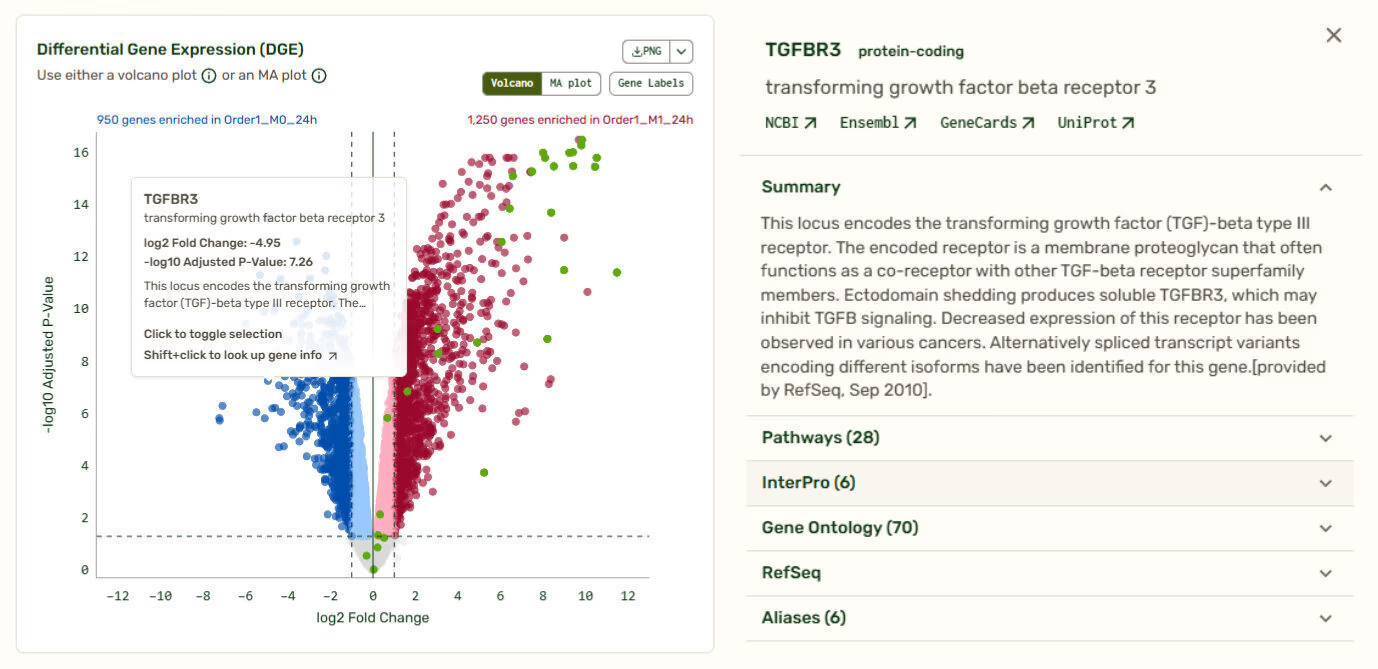
Learn more about the interactive plots in our blog, Breaking down bioinformatics barriers for rapid RNA-Seq analysis, and explore them firsthand through the live demo on our RNA-Seq product page.
RNA-Seq, optimized for everyday research
Plasmidsaurus RNA-Seq works because every part of the sequencing experience has been built to move quickly together: the logistics network that moves samples efficiently, the automation that keeps workflows consistent at scale, the 3′ end counting strategy that streamlines processing, and the bioinformatics pipeline that turns data into results researchers can use.
Together, those pieces make RNA-Seq feel less like a major undertaking and more like a tool scientists can reach for whenever the biology calls for it.