Eukaryotic Whole Genome
How it works
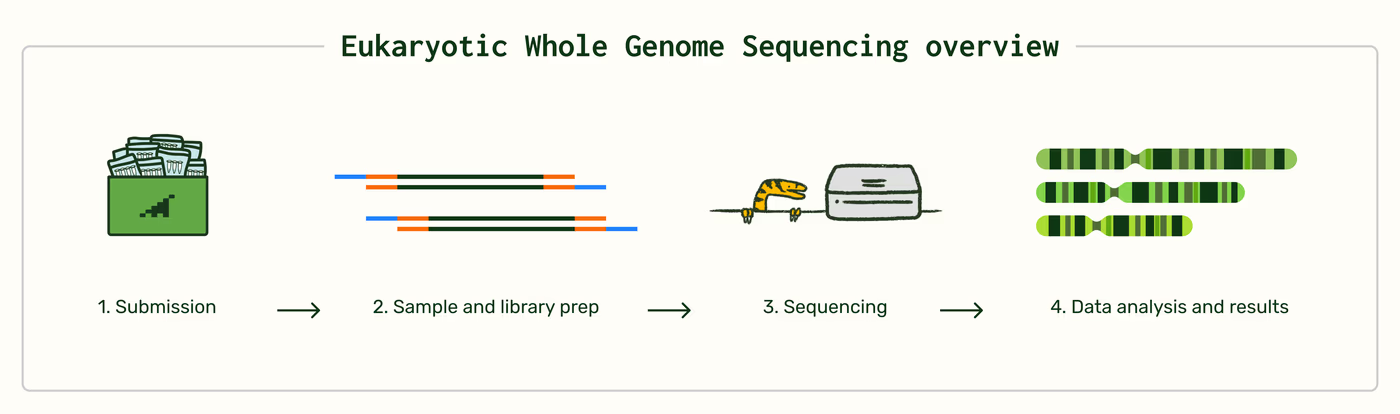
Plasmidsaurus Eukaryotic Whole Genome Sequencing uses Oxford Nanopore long-read sequencing to produce de novo assemblies and annotation of reference-quality genomes from clonal populations of fungi or multicellular eukaryotic species.
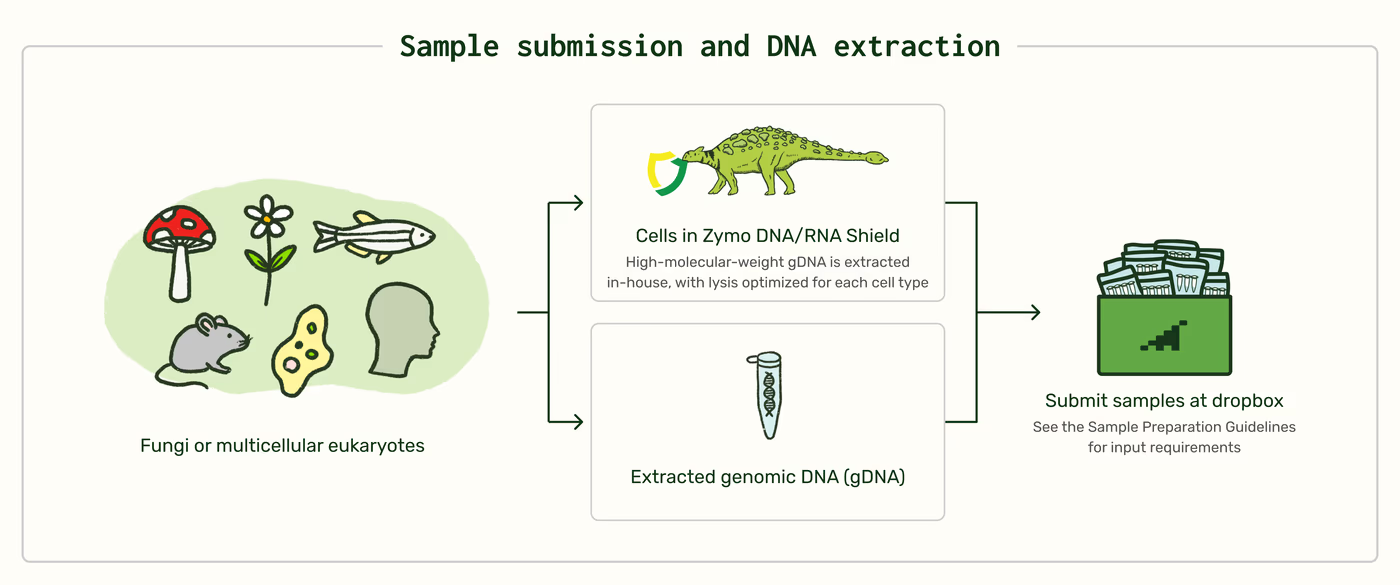
Samples may be submitted either as extracted genomic DNA (gDNA) or as cells preserved in Zymo DNA/RNA Shield. Refer to the Sample Preparation Guidelines for detailed input requirements.
For samples submitted as cells, genomic DNA is extracted using a lysis method appropriate for the cell-type that is optimized to reliably generate high-quality de novo assemblies. Our extraction process is designed for cells without a cell wall. We can process a limited set of species and cell types; review the Sample Preparation Instructions to confirm that your sample is supported.
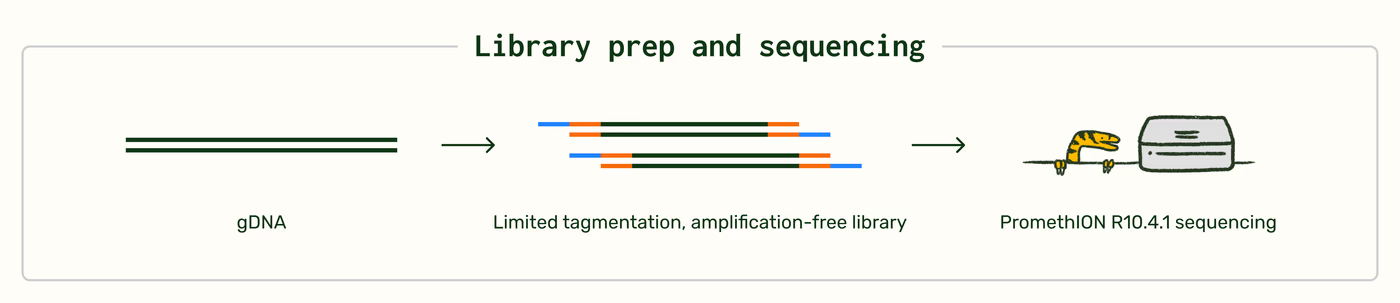
Oxford Nanopore sequencing library preparation: gDNA first undergoes limited, sequence-independent fragmentation via tagmentation, then is built into an amplification-free sequencing library using Oxford Nanopore's v14 chemistry. Libraries are sequenced with a primer-free protocol on Oxford Nanopore PromethION R10.4.1 flow cells. If you require ligation-based ONT library preparation, please contact support for custom projects.
Bioinformatics
Oxford Nanopore raw reads are quality filtered, used to estimate genome size and ploidy, downsampled to a 100× coverage target when needed, and assembled de novo. The assembly is then annotated and evaluated for completeness.
Depending on the genome complexity and availability of reference information for your organism’s genome, de novo assembly and annotation are not guaranteed.
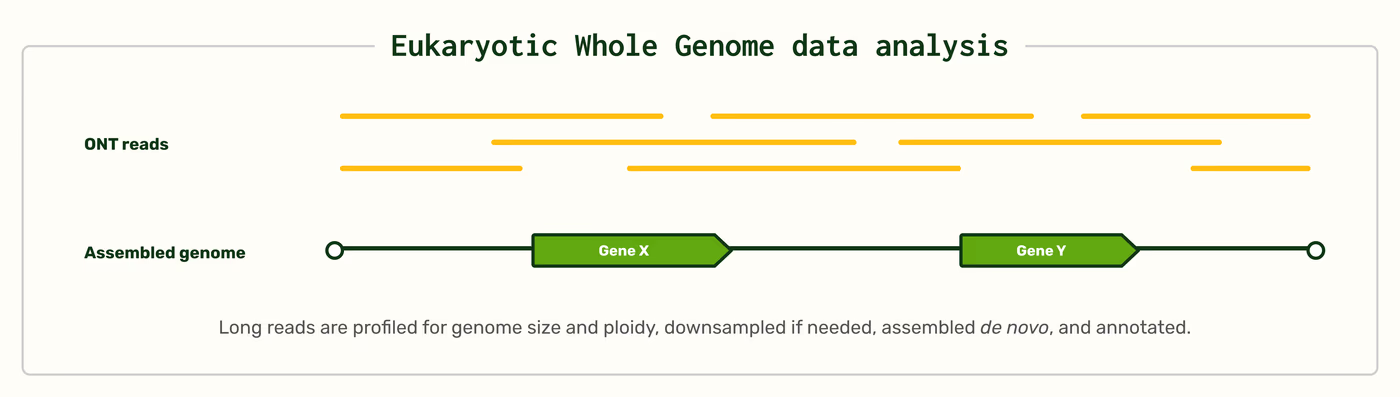
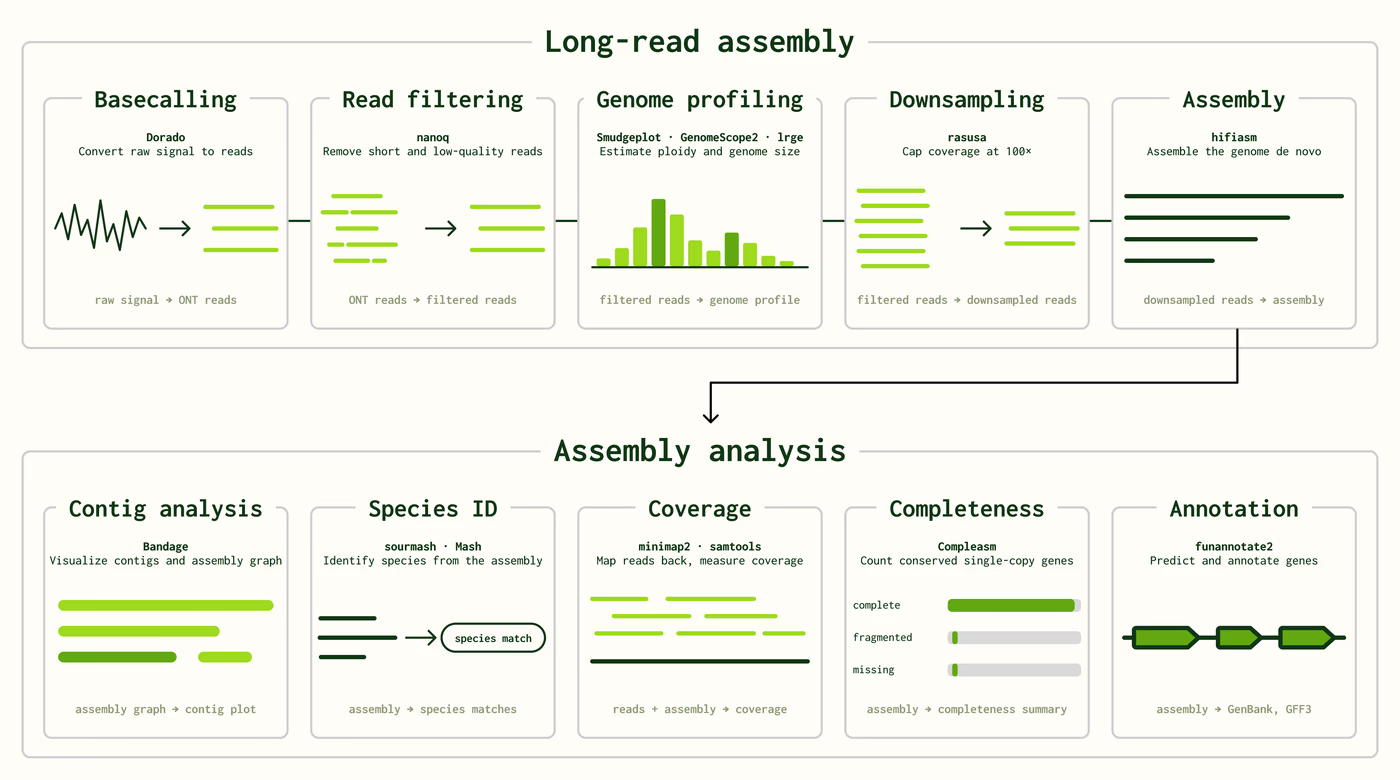
Detailed bioinformatics methods below.
| Step | Substep | Software | Method and parameters |
|---|---|---|---|
| Basecalling | — | Dorado | Performs High Accuracy basecalling with default Q9 quality filtering. |
| Quality filtering | — | nanoq | Removes reads shorter than 1 kb and reads with quality scores below 7. |
| Genome profiling and coverage normalization | — | Smudgeplot; GenomeScope 2.0; LRGE | Estimates ploidy (Smudgeplot) and genome size (GenomeScope2, with LRGE as a fallback) from the filtered reads, then computes estimated coverage against a 100× target. |
| Downsampling | — | rasusa | Downsamples reads to the 100× coverage target when the estimated coverage exceeds it. Samples already at or below the target, or where profiling fails, proceed with the full filtered read set. |
| Assembly | — | hifiasm | Generates a de novo assembly using parameters selected for high-quality Oxford Nanopore reads. |
| Analysis | Genome annotation | funannotate2 | Cleans and prepares the genome assembly; predicts genes using multiple methods, including AUGUSTUS, GeneMark-ES, SNAP, and GlimmerHMM; performs automated ab initio training; incorporates transcript and protein alignment evidence; assigns functional annotations using databases including Pfam, dbCAN, MEROPS, and Swiss-Prot; and evaluates genome completeness using BUSCO. |
| Contig analysis | Bandage | Analyzes contigs and assembly structure. |
Data and deliverables
Filename key
ORDERCODEUnique order identifier, such as
JPY6QT.OSIDOrder-sample identifier, such as
JPY6QT_1, used to trace files back to a specific tube.SAMPLECustomer-provided sample name, such as
Control_rep_1. Used with the OSID in filenames like<OSID>_<SAMPLE>.
Download Results button <ORDERCODE>_results.zip
Results generated from automated data analysis pipeline.
| File or deliverable | Description |
|---|---|
<OSID>_<SAMPLE>_report.html | A standalone HTML report for the sample. It has the same summary numbers and charts as the online results page, saved as a file you can keep or share. |
<OSID>_<SAMPLE>/<OSID>_<SAMPLE>_summary.txt | A plain-text summary table of key stats: total bases and reads sequenced, longest read, estimated coverage, bases and coverage used for assembly, genome size, contig count, and N50. |
<OSID>_<SAMPLE>/<OSID>_<SAMPLE>_reference.fasta | The assembled genome sequence itself, in FASTA format — no gene annotations. |
<OSID>_<SAMPLE>/<OSID>_<SAMPLE>.gbk | The assembled genome with gene annotations, in GenBank format. Compatible with SnapGene, Geneious, and similar tools. Present when gene annotation succeeds; may be absent for low-completeness assemblies. |
<OSID>_<SAMPLE>/<OSID>_<SAMPLE>.gff | The assembled genome's gene annotations in GFF3 format. Same availability caveat as the .gbk file. |
<OSID>_<SAMPLE>/<OSID>_<SAMPLE>_compleasm-summary.txt | Assembly completeness in the classic BUSCO short-summary format (S/D/F/I/M percentages and counts, lineage, total searched), from the Compleasm tool. |
<OSID>_<SAMPLE>/<OSID>_<SAMPLE>_busco-short-summary.txt | A combined completeness report: the same assembly-completeness numbers as above, plus (when annotation succeeds) a second section with the predicted species, gene/exon counts, and functional-annotation stats from funannotate2. |
<OSID>_<SAMPLE>/<OSID>_<SAMPLE>_ont-stats.tsv | Basic stats on your raw sequencing reads: average and median read length, N50, and read count. |
<OSID>_<SAMPLE>/<OSID>_<SAMPLE>_contigs.png | A plot showing the size and coverage of each assembled contig. |
<OSID>_<SAMPLE>/<OSID>_<SAMPLE>_contigs.txt | A plain-text list of the assembled contigs, with length and coverage. |
<OSID>_<SAMPLE>/<OSID>_<SAMPLE>_reads.png | A plot showing the length and quality distribution of your reads. |
FASTQ button <ORDERCODE>_fastq.zip
| File or deliverable | Description |
|---|---|
<OSID>_<SAMPLE>.fastq.gz | The raw sequencing reads for the sample, before quality filtering. |
Online results page
| File or deliverable | Description |
|---|---|
| Results by sample | Per-sample cards showing pass/fail status and sample name, each with a "View Report" link to the standalone HTML report (a failed tube links to the sequencing-failure FAQ instead). |
Technical notes and related guides
Performance and troubleshooting
If coverage is sufficient, we typically see assembled contigs with ~Q50 (99.999%) accuracy.
Reruns
Whole Genome Sequencing outcomes depend heavily on the quantity, quality, and purity of the submitted sample. For this reason, Plasmidsaurus does not guarantee that every sample will meet the target raw-data yield or produce a high-quality, high-coverage genome assembly.
When a sample does not meet the applicable performance criteria, we review the initial sequencing results to determine whether additional sequencing is likely to improve the outcome. Eligible samples are automatically queued for one complimentary rerun, which may include protocol adjustments. Data from the initial run and rerun are combined for downstream assembly and analysis.
For the 1 Gb, 5 Gb, and 15 Gb service tiers, a sample is considered unsuccessful if it produces less than 75% of the selected raw-data target. For example, a sample submitted at the 1 Gb tier is considered unsuccessful if it produces less than 750 Mb.
Unsuccessful samples are automatically queued for a complimentary rerun unless our review indicates that the remaining sample quantity or quality is unlikely to support an improved result.
For the Full Flow Cell tier, a sample is considered complete when it produces at least 50 Gb of raw sequencing data. Samples producing less than 50 Gb are reviewed to determine whether a complimentary rerun is likely to improve the outcome.
If a rerun is not recommended, we will contact you to discuss next steps. Depending on the circumstances, these may include:
- A reduced $200 fee to cover library preparation and reagent costs when the flow cell was terminated early
- Resubmission of higher-quality DNA for a new sequencing attempt
Additional sequencing attempts
If the target data yield or an acceptable assembly is not achieved after the complimentary rerun, no further complimentary reruns will be performed. Charges still apply to unsuccessful samples because library preparation, sequencing, analysis, and additional review have already been completed.
To attempt sequencing again, submit a new sample that meets all applicable sample preparation and quality-control requirements and place a new sequencing order.